

















Featured

News

لا يشبه الذكاء الاصطناعي (AI) أي موجة تكنولوجية سابقة. فهو لا يُعيد فقط تعريف طريقة عمل الشركات، بل يُعيد رسم الحدود الجيوسياسية بين دول متقدمة تمتلك أدوات القيادة الرقمية، وأخرى نامية تحاول اللحاق بركب سريع التطور. وبينما تبشر هذه التقنية بإنتاجية غير مسبوقة وفرص اقتصادية هائلة، إلا أن تركيز القوة في يد عدد محدود من الشركات والدول ينذر بتوسيع فجوة عالمية باتت أصعب على الدول النامية تجاوزها.

وفي زمن يتغير فيه الاقتصاد بسرعة عالية جدا، لم تعد فرص الريادة تُصنع فقط من الأفكار، بل من القدرة على التفاعل مع موجات التكنولوجيا العميقة، وعلى رأسها الذكاء الاصطناعي. فهذه التقنية لا تمثل مجرد تطور تقني، بل تحول جذري في طريقة التفكير، العمل، والتوسع. وعليك أن تتخيل عالماً يستطيع فيه الذكاء الاصطناعي كتابة عقودك القانونية، تصنيف بيانات عملائك، تطوير حملاتك الإعلانية، وحتى بناء منتجك الأولي في أيام قليلة. هذه لم تعد خيالات، بل واقع يُعاد تشكيله الآن، ويستدعي من رواد الأعمال أن يتحركوا بسرعة، وذكاء.

الاقتصاد الجديد: من يمتلك الذكاء الاصطناعي يكتب القواعد

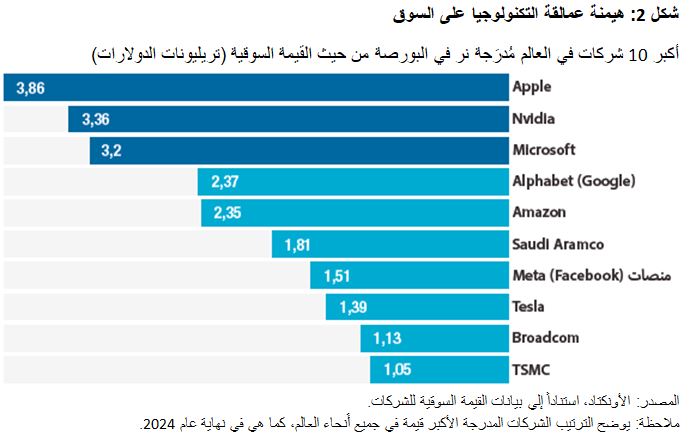
تشير تقديرات تقرير الأونكتاد للتكنولوجيا والابتكار 2025 إلى أن قيمة السوق العالمية للتكنولوجيات الرائدة ستصل إلى 16.4 تريليون دولار بحلول 2033، وسيمثل الذكاء الاصطناعي النصيب الأكبر منها (4.8 تريليون دولار) (شكل 1). ما يميز هذه الموجة أنها لا تكتفي بأتمتة المهام الروتينية، بل تقتحم مجالات معرفية كانت حكرًا على البشر - كالتحليل القانوني، والتشخيص الطبي، والتصميم الإبداعي.

خلاًفاً للتكنولوجيات السابقة، يتمتع الذكاء الاصطناعي بالقدرة على تغيير مجموعة واسعة من المهام المعرفية التي كانت في السابق حكراً على العمال ذوي المهارات العالية. ويمكن أُن يُغيّر استخدام الذكاء الاصطناعي مجموعة واسعة من المهام، ولاسيما المهام المعرفية التي كانت تعتبر في السابق حكراً على العمال ذوي المهارات العالية. ويمكن للذكاء الاصطناعي التوليدي، على سبيل المثال، أُن يقوم بتوليد النصوص وإنتاج الصور ومقاطع الفيديو وكتابة التعليمات البرمجية الحاسوبية وتحديد الأنماط المعقدة في البيانات للخدمات القائمة على المعرفة. وتشير الأبحاث التي أُجريت حتى الآن إلى أُنه يمكن للشركات التي تستخدم الذكاء الاصطناعي أُن تحقق مكاسب هامة من حيث الإنتاجية، ولا سيما تلك التي توظف عمالا مهرة وتلك التي تعمل في صناعات الخدمات.

لكن ماذا يعني هذا لرائد أعمال في الرياض أو نيروبي أو ساو باولو؟ الإجابة بسيطة: أن فرص النمو الحقيقية تكمن في فهم أين توجد الفجوات، وأين يمكن بناء حلول محلية تعتمد على الذكاء الاصطناعي، سواء في التعليم، الصحة، الزراعة، أو الخدمات المالية.
الشركات الرائدة في الذكاء الاصطناعي

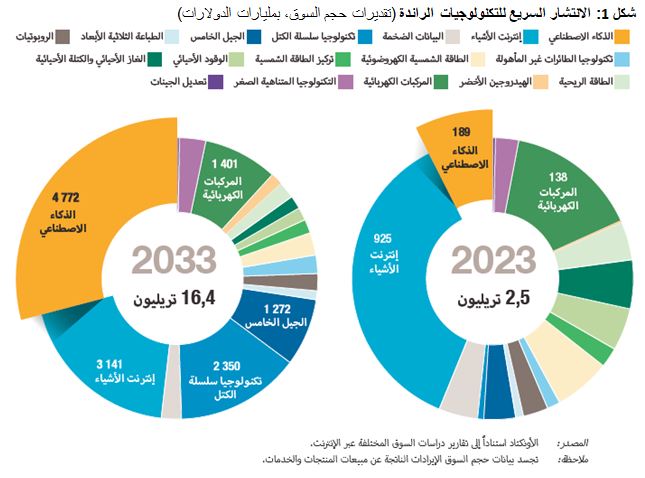
يعَدُ كبار موردي التكنولوجيات الرائدة الان من بين أُكثر الشركات قيمةً سوقيةً في العالم. وتبلغ القيمة السوقية لكل ابل ونيفيديا وميكروسوفت (Microsoft و NvidiaوApple) أُكثر من 3 تريليون دولارا أُمريكيا، أُي ما يقارب إجمالي الناتج المحلي للقارة الافريقية، أُو إجمالي الناتج المحلي للمملكة المتحدة وأُيرلندا الشمالية، سادس أُكبر اقتصاد في العالم. والشركات الخمس الأولى هي شركات من الولايات المتحدة الأمريكية، وتعتبر ثلاث شركات رائدة في صناعة الرقائق الالكترونية (TSMC و BroadcomوNvidia)، من بين الشركات العشر الأولى في العالم، وتركز كلها تقريبا على التكنولوجيا الرائدة وتستثمر بكثافة في الذكاء الاصطناعي (شكل 2)[1].

وهناك أُيضاً تركيز كبير على الاستثمار في البحث والتطوير في عدد قليل من البلدان. وفي عام 2022 ، نفُذ 40 في المائة من عمليات البحث والتطوير الممولة من الشركات في جميع أُنحاء العالم من قبل 100 شركة فقط، يقع المقر الرئيسي لنصفها تقريبا في الولايات المتحدة، وعلى رأسها Alphabet و Metaو Microsoft وApple، فيما يقع مقر حوالي 13% منها في الصين، تتزعمها شركتا Huawei وTencent، بعد أن كانت نسبتها 2% قبل 10 سنوات، متجاوزة بذلك رواد مجال البحث والتطوير التقليدية مثل أُلمانيا واليابان وجمهورية كوريا وسويسرا والمملكة المتحدة. ولا ينتمي أُي من أُكبر 100 شركة مستثمِرة في مجال البحث والتطوير إلى البلدان النامية، باستثناء الصين. وتهدد الهيمنة على السوق، سواء على مستوى الشركات أُو على المستوى الوطني، بتوسيع الفجوات التكنولوجية العالمية، مما يزيد من صعوبة التحاق المتأخرين بالركب.

[1] Broadcom وNvidia الولايات المتحدة، TSMC مقاطعة تايوان الصينية.
الفجوة التي تفصل الدول المتقدمة والنامية في الذكاء الاصطناعي

بالرغم من الفرص الكبيرة التي يوفرها الذكاء الاصطناعي، الا ان استغلال هذه التكنولوجيا يحتاج الى توفر البيئة المناسبة، ولهذا يلقي التقرير الضوء على الفجوات الرقمية الكبيرة بين الدول، والتي من شأنها أن تتّسع أكثر مع ظهور الذكاء الاصطناعي. وقد أشار الى أنه فيما يتعلق بالبنية التحتية، على سبيل المثال، تمتلك الولايات المتحدة حوالي ثلث أُفضل 500 من الحواسيب العملاقة وأُكثر من نصف الأداء الحاسوبي الكلي. ويقع معظم مراكز البيانات أُيضاً في الولايات المتحدة. في المقابل فان هناك قدرات محدودة في مجال البنية التحتية للذكاء الاصطناعي للبلدان النامية، باستثناء كل من البرازيل والصين والهند والاتحاد الروسي، وهو ما يعيق قدرتها على اعتماد الذكاء الاصطناعي وتطويره. وتتجلى فجوة الذكاء الاصطناعي أُيضاً في قلة مقدمي الخدمات والاستثمار وقلة توليد المعارف.

ولذلك، يدعو التقرير إلى تطوير الذكاء الاصطناعي على أساس الشمول والانصاف، ويؤكد التقرير على ضرورة أن تكون تكنولوجيات الذكاء الاصطناعي بمثابة مُكمّل لعمل البشر بدلاً من أن تحل محله، كما أنه ينبغي إعادة هيكلة الانتاج حتى تُتقاسم المزايا بشكل عادل بين البلدان والشركات والعمال.

الركائز الجوهرية الثلاث لتسريع وتيرة التقدم في الذكاء الاصطناعي

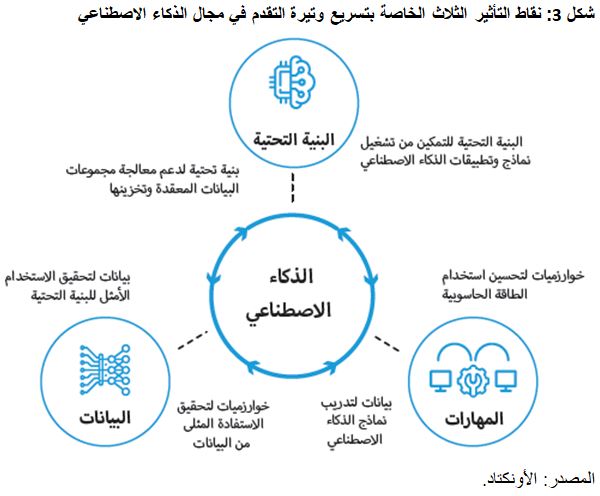
يشير تقرير الأونكتاد إلى ثلاث ركائز جوهرية لتسريع وتيرة التقدم في الذكاء الاصطناعي (شكل 3):

  1. البنية التحتية

ليست الكهرباء والإنترنت وحدها ما يحدد مدى جاهزية دولة ما، بل القدرات الحاسوبية المتقدمة، مثل وحدات المعالجة الرسومية (GPUs) والخوادم العملاقة. تمتلك الولايات المتحدة وحدها ثلث أفضل 500 حاسوب عملاق عالميًا، بينما لا تملك معظم الدول الإفريقية أي وجود في هذا التصنيف.

حتى الدول ذات دخل متوسط كالبرازيل أو جنوب إفريقيا تعاني من غياب مراكز بيانات قادرة على استضافة نماذج AI ضخمة مثل GPT-4 أو Claude. وعدم توفر هذه البنية يحد من قدرة الباحثين المحليين على تجريب النماذج أو تدريب نماذجهم الخاصة، مما يجعلهم معتمدين بالكامل على مزودي خدمات في الدول الصناعية.

  1. البيانات

الذكاء الاصطناعي لا يتغذى إلا على البيانات. لكن في الدول النامية، البيانات إما غير متوفرة، أو مشتتة، أو غير قابلة للاستخدام بسبب ضعف البنية القانونية. الدول التي تمتلك سياسات متقدمة لحوكمة البيانات مثل الاتحاد الأوروبي (من خلال لائحة GDPR) تتمتع بميزة تنافسية في جذب استثمارات الذكاء الاصطناعي.

في المقابل، تعاني بلدان مثل نيجيريا أو بنغلاديش من ضعف في تنظيم البيانات، وغياب معايير موحدة، مما يعيق تدريب النماذج محليًا ويعرّض الخصوصية المجتمعية للخطر.

  1. المهارات

الركيزة الأهم ربما هي المهارات. فبدون مطورين، وعلماء بيانات، ومهندسي خوارزميات، لا يمكن لأي دولة أن تكون فاعلة في بيئة الذكاء الاصطناعي. تحتل الولايات المتحدة الصدارة من حيث عدد المطورين على منصة GitHub، تليها الهند والصين.

لكن هناك بصيص أمل. دول مثل نيجيريا وغانا وكينيا شهدت نموًا بلغ 40% في عدد المطورين خلال السنوات الأخيرة، وأصبحت مراكز إقليمية ناشئة تجذب شركات تكنولوجيا ناشئة واستثمارات في حاضنات الأعمال. على سبيل المثال، أنشأت Andela، وهي شركة نيجيرية، شبكة لتدريب وتوظيف مطوري الذكاء الاصطناعي في جميع أنحاء القارة.
 

تعتبر المهارات من النقاط المهمة لشرط الجاهزية للاستفادة من الذكاء الاصطناعي. وقد عمدت الدول المتقدمة والعديد من الدول الصاعدة الى الاهتمام بالمهارات الخاصة بالذكاء الاصطناعي وهي مسألة هامة للتمركُز الاستراتيجي من أجل الاستفادة من الذكاء الاصطناعي. وتضم الولايات المتحدة العدد الأكبر من المطورين، تليها الهند والصين، اللتان تتوفران أُيضاً على أُكبر عدد من السكان في العالم. كما عززت بعض البلدان النامية في أُفريقيا وجنوب شرق آسيا البنية التحتية لدعم استخدام الإنترنت عبر توفير الشبكات عبر الحدود. وحققت الصين ميزة قوية من حيث يسر تكلفة البيانات وكميتها. وكوّنت الهند والصين والبرازيل مجموعات كبيرة من مطوري الذكاء الاصطناعي.

تضم الولايات المتحدة أكبر عدد من المطورين على منصة ([1]GitHub)، تليها الهند والصين (شكل 4)، كما تمتلك كل من الصين والهند كتلة كبيرة من مطوري الذكاء الاصطناعي، مما يمنحهما موقعًا متميزًا في تطوير الذكاء الاصطناعي وإنتاج المعرفة العلمية المتعلقة به.

ووفقا لبيانات أونكتاد فقد شهد العديد من البلدان النامية نموًا سريعًا في عدد المطورين. وسُجّلت أسرع نسبة زيادة، بلغت 40 في المائة، في نيجيريا وغانا وكينيا، التي أصبحت مراكز واعدة لشركات التكنولوجيا. كما أن النمو في عدد المطورين كان ملحوظًا في أمريكا اللاتينية ومنطقة البحر الكاريبي، على سبيل المثال في الأرجنتين وبوليفيا وكولومبيا والبرازيل. أما في آسيا ومنطقة المحيط الهادئ، فإن الهند وفيتنام وإندونيسيا والفلبين كانت تمتلك بالفعل عددًا كبيرًا من المطورين.

[1]:GitHub هو منصة إلكترونية تُستخدم لإدارة الإصدارات وتطوير البرمجيات بشكل تعاوني. تُمكّن المطورين من تخزين الشيفرة البرمجية وإدارتها وتتبع التعديلات باستخدام نظام Git، وتُستخدم على نطاق واسع من قبل الأفراد والشركات والمجتمعات، وتدعم المشاريع المفتوحة والمغلقة المصدر.


مؤشر الجاهزية مؤشر الجاهزية للتكنولوجيات الرائدة

أطلق الأونكتاد مؤشر الجاهزية للتكنولوجيات الرائدة لقياس مدى استعداد الدول لتبني التكنولوجيات مثل الذكاء الاصطناعي. حيث تصدرت الولايات المتحدة المؤشر، تليها السويد والمملكة المتحدة وهولندا، فيما تأتي سويسرا في المركز السادس، حيث تأتي هذه الدول في أعلى التصنيف بفضل استثمارها في البحث والتطوير، وجودة مؤسساتها التعليمية، وابتكاراتها الصناعية. في المقابل، أحرزت دول صاعدة تقدما ملحوظا في هذا المجال، فقد احرزت الصين تقدما ملحوظا وحازت على المرتبة 21 بعد أن كانت في المركز 28، فيما قفزت الهند الى المرتبة 36 بعد أن كانت في المركز 48، اما البرازيل فقد حازت على المرتبة 38 بعد أن كانت في المركز 40، وتعتبر هذه النتائج نتيجة للسياسات الحكومية النشطة في التعليم والابتكار، والشراكة مع القطاع الخاص لإنشاء مراكز تميز.

في المقابل، لا تزال الدول العربية، رغم طموحاتها الرقمية، في موقع متأخر نسبيًا. باستثناء الإمارات والسعودية، تُظهر المؤشرات فجوة بين الطموح والواقع بالاستناد الى الأرقام والبيانات.

ويُعزى تقدم الهند جزئيًا إلى السياسات الحكومية، حيث تعاونت الحكومة على مدار السنوات بشكل وثيق مع القطاع الخاص والمؤسسات الأكاديمية لإنشاء مراكز تميز، مثل المعهد الهندي للتكنولوجيا في حيدر أباد والمعهد الهندي للتكنولوجيا في خراجبور في مجال الذكاء الاصطناعي، ومركز كوتاك للذكاء الاصطناعي وتعلم الآلة في المعهد الهندي للعلوم، ومركز التميز في علوم البيانات والذكاء الاصطناعي التابع للرابطة الوطنية لشركات البرمجيات والخدمات. كما تعمل البرازيل على تنمية المواهب في مجال الذكاء الاصطناعي، على المستويين الفيدرالي والالوية. فعلى سبيل المثال، ومن خلال شراكات استراتيجية بين المؤسسات العامة والخاصة، أنشأت مؤسسة الأبحاث في ولاية ساو باولو شبكة من مراكز البحوث التطبيقية.

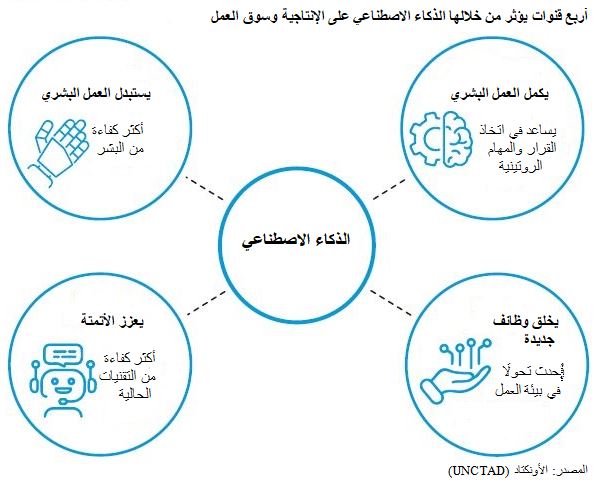
قنوات التأثير الرئيسية للذكاء الاصطناعي على الإنتاجية والقوى العاملة:

يمكن للذكاء الاصطناعي التأثير على العمل البشري والإنتاجية غالبًا بشكل متزامن من خلال أربع قنوات رئيسية:

  1. استبدال العمل البشري:

يستخدم الذكاء الاصطناعي كبديل للبشر في المهام التي تتفوق فيها الآلات من حيث الكفاءة، مما يؤدي إلى تقليل الاعتماد على العمالة البشرية لصالح رأس المال. مثال: في البنوك، يمكن للذكاء الاصطناعي تحليل آلاف المعاملات وكشف الاحتيال بدلاً من الاعتماد على المراجعة اليدوية.

  1. تكامل مع العمل البشري:

يعزز الذكاء الاصطناعي من كفاءة ومهارات البشر من خلال أداء المهام الروتينية (مثل تصحيح المستندات أو جدولة الاجتماعات)، مما يتيح للبشر التركيز على المهام التي تتطلب مهارات إنسانية. مثال: في الطب، يمكنه المساعدة في تشخيص الأمراض عبر تحليل الصور الطبية بطريقة أدق من قدرة الإنسان.

  1. تعميق الأتمتة:

يحل الذكاء الاصطناعي محل تقنيات أقل كفاءة ويزيد من مستوى الأتمتة. مثال: روبوتات المحادثة المدعومة بالذكاء الاصطناعي (مثل "الذكاء الاصطناعي التوليدي") توفر خدمة عملاء أكثر دقة من الأنظمة التقليدية.

  1. خلق وظائف جديدة:
    يؤدي الذكاء الاصطناعي إلى ظهور وظائف جديدة مثل: مدربي الذكاء الاصطناعي (لتحسين النماذج)، مفسري الذكاء الاصطناعي (لتكييفه مع حالات استخدام محددة)، محافظي الذكاء الاصطناعي (لمراقبة الأخلاقيات والأداء).
الذكاء الاصطناعي كمنفعة عامة... أم كأداة احتكار؟

تشير تجربة الإنترنت إلى أن غياب الحوكمة العالمية يمكن أن يُحوّل التقنيات إلى أدوات احتكار. ومع أن الذكاء الاصطناعي يقدّم فوائد غير مسبوقة، إلا أن تقنين استخدامه، وتحديد حقوق الوصول إلى البيانات، ومراعاة الخصوصية، جميعها تتطلب تنسيقًا دوليًا معقدًا.

كما يحذر تقرير الأونكتاد من ترك الذكاء الاصطناعي بالكامل في يد القطاع الخاص، الذي قد لا يعطي أولوية لمصالح المجتمعات مقارنة بالربح. ولهذا، هناك دعوة لاعتبار الذكاء الاصطناعي "منفعة عامة عالمية"، على غرار الصحة أو المناخ.

كما يؤكد على ضرورة التعاون الدولي نظرا لوجود تأثيرات عابرة للحدود لأن الذكاء الاصطناعي يشتمل على سلع وخدمات غير ملموسة يمكن محاكاتها واستخدامها في أُي مكان تقريباً. حيث يؤكد على أهمية ضمان توفير الذكاء الاصطناعي كمنفعة عامة والتعاون بين أُصحاب المصلحة المتعددين لجعله متاحاً ومنصفاً ومفيداً للجميع، وتعزيز الأبتكار الشامل من أُجل مواجهة التحديات العالمية.

التوصيات

تطوير استراتيجيات وطنية: استنادًا إلى التقرير، يجب صياغة رؤية شاملة ومتكاملة لسياسات الذكاء الاصطناعي في البلدان النامية، تركّز على الاستخدام العادل والفعال للتكنولوجيا كأداة للتنمية المستدامة، وبالنسبة لتكنولوجيات رائدة، كالذكاء الاصطناعي، لا بد من مواكبة هذا التطور كي لا يقوّض الميزة النسبية التقليدية للبلدان النامية المتمثلة في انخفاض تكلفة اليد العاملة، وهو ما يتطلب إعادة النظر في السياسات الاقتصادية لهذه البلدان لتجنّب الوقوع في فخ التبعية التقنية.

الاستثمار في التعليم المهني والجامعي المتخصص: كما أن هناك ضرورة لتمكين العاملين وإعادة تأهيلهم للقيام بأدوار جديدة تتماشى مع التحولات الرقمية، وإشراكهم في تصميم أدوات الذكاء الاصطناعي، لضمان أن تكون التكنولوجيا مكمّلة للعمل البشري لا بديلاً عنه. وفقا للتقرير فان هناك حاجة لتبني استراتيجيات تسريع وطنية تعتمد على تكييف حلول الذكاء الاصطناعي مع البنية التحتية المتاحة محليًا، وتوسيع نطاق استخدام البيانات المتوفرة، وتبسيط واجهات الاستخدام، مع إقامة شراكات استراتيجية للحصول على الموارد والخبرات اللازمة. كما أن هناك حاجة لبرامج محو الأمية الرقمية والتدريب المهني وإعادة التأهيل الوظيفي، بما يضمن تحوّلاً شاملاً لا يستثني أحدًا من ثمار التكنولوجيا. وفي هذا الاطار هناك دور هام للسياسات المالية في دعم هذا التحول، من خلال تخصيص تمويل موجّه للبحث والتطوير، واستخدام الحوافز الضريبية لتشجيع التكنولوجيا التي تدعم العمل البشري وتحفّز على الابتكار المحلي، ما يقلل من هجرة الكفاءات.

إنشاء صناديق سيادية للاستثمار في البحث والتطوير: يجب أن تتبنى الحكومات تموضعًا استراتيجيًا واضحًا يقوم على تقييم القدرات الوطنية في الذكاء الاصطناعي عبر ثلاث ركائز: البنية التحتية، والبيانات، والمهارات، مع تحديد الثغرات واقتراح مسارات لحلول واقعية. ويعزز هذا التقييم القدرة على تصميم سياسات فعّالة تدفع بالنمو الاقتصادي الرقمي وتفتح المجال أمام المنافسة الدولية.

ووفقا للتقرير فان معالجة نقاط التأثير الثلاث – البنية التحتية، البيانات، المهارات – هو شرط جوهري لخلق بيئة مواتية للذكاء الاصطناعي. إذ يتطلب تحديث البنية التحتية الرقمية ضمان الوصول الشامل للكهرباء والإنترنت، كما أن مشاركة البيانات عالية الجودة وتعزيز المعايير الأخلاقية والقانونية المرتبطة بها ضروري لدعم الابتكار الآمن. أما على صعيد المهارات، فإن نشر المعرفة بالذكاء الاصطناعي من التعليم الأساسي وحتى المستويات المهنية، هو مفتاح رئيسي لتعزيز قدرات الدول النامية على المنافسة.

تبنّي سياسات بيانات مفتوحة وآمنة تحفّز الابتكار المحلي: وأخيرًا، فإن تبنّي نهج متعدد أصحاب المصلحة يُعد ضروريًا لتحقيق التوازن بين الابتكار والثقة العامة والسلامة، مع إيلاء اهتمام خاص للفئات الضعيفة والمهمّشة لضمان ألا يتسبب التحول الرقمي في تعميق الفجوات الاجتماعية والاقتصادية.

إن الذكاء الاصطناعي الشامل للجميع، كما يطرحه التقرير، ليس خيارًا تقنيًا فحسب، بل رؤية تنموية متكاملة تتطلب قيادة سياسية، تنسيق مؤسسي، واستثمارًا طويل الأجل في الإنسان والبنية المعرفية.

كما يشكل التعاون الدولي ركيزة أساسية لضمان تطوير الذكاء الاصطناعي كمنفعة عامة عالمية. فالتحديات المرتبطة بالذكاء الاصطناعي، من حيث الأمن، الخصوصية، التحيز الخوارزمي، والتحكم في البيانات، تتجاوز الحدود الوطنية وتتطلب تنسيقًا عالميًا واسع النطاق.

يرى تقرير الأونكتاد أن الذكاء الاصطناعي لا يجب أن يكون امتيازًا للدول الغنية أو للشركات العملاقة، بل منفعة عامة. لكن هذا لن يحدث تلقائيًا. يتطلب الأمر قيادة من رواد أعمال قادرين على التفكير محليًا والعمل عالميًا، وبناء نماذج تجارية تربح وتحل مشاكل حقيقية. ويتوجب عليهم انتهاز الفرصة والتطلع الى يمكن تقديمه. الذكاء الاصطناعي هو أعظم فرصة تجارية في هذا العقد. والسؤال الحقيقي: هل أنت مستعد لركوب الموجة؟ أم ستشاهدها من الشاطئ؟


Economy

Algeria

10 Mar 2015

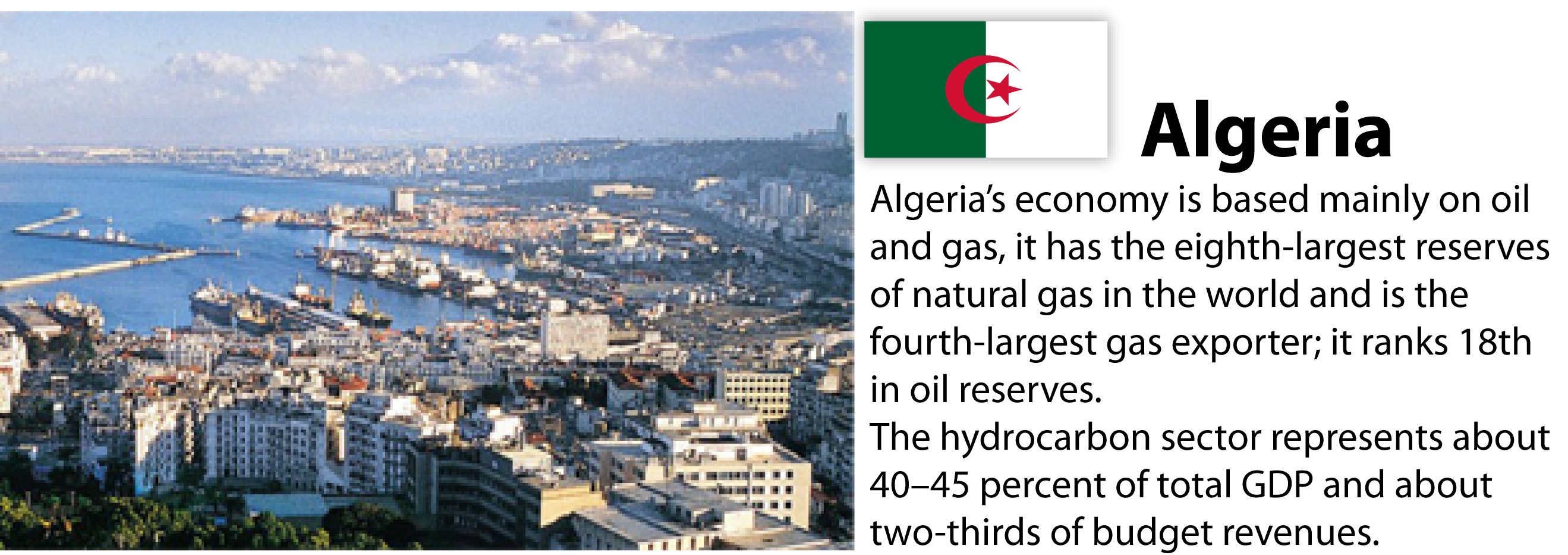
  Economy of Algeria Algeria’s economy is based mainly on oil and gas, it has the eighth-largest reserves of natural gas in the world and is the fourth-largest gas exporter; it ranks 18th in oil reserves. The hydrocarbon sector represents about 40–45 percent of total GDP and about two-thirds of budget revenues. Oil and gas resources account for 98 percent of the country’s exports and 70 percent of tax revenues. The chief challenges that Algeria faces in the short and medium terms are the need to diversify the economy, strengthen political and economic reform, improve the business climate, reduce regional inequalities and create jobs. Structural reform within the economy, such as development of the banking sector and the construction of infrastructure, moves ahead slowly. According to the World Bank indicator for ease of doing business in 2015, Algeria is ranked 154 out of 183 economies.   Essential Information   Area: 2,381,741 sq kmCapital: AlgiersPrincipal Towns: Oran, Constantine, Annaba, Stiff, Blida, Sidi Bel Abbes, Skikda, Batna, Tlemcen.Languages: Arabic is the official language but French is still widely used. There are Berber-speaking minorities.Climate: The coast has a moderate climate with temperatures ranging from 13 to 32°C. The summer months of June to September can be hot and humid with daytime temperatures registering between 27 and 32°C; these can be exceeded, for brief periods, when the hot, dry sirocco wind blows from the southCurrency: 1$ = 78.9 Algerian dinar (DZD). DEMOGRAPHY 39,5 (Million 2015 est.) (source: IMF) 0-14 years: 28.4% (male 5,641,148/female 5,378,207) 15-24 years: 17.4% (male 3,451,069/female 3,291,166) 25-54 years: 42.8% (male 8,398,770/female 8,209,634) 55-64 years: 6.2% (male 1,230,865/female 1,186,832) 65 years and over: 5.2% (male 931,769/female 1,094,262) (2014 est.) Source: CIA factbook. EducationLiteracy: definition: age 15 and over can read and write total population: 80.2% male: 87.2% female: 73.1% (2015 est.) (Source: CIA factbook). NATURAL RESOURCESpetroleum, natural gas, iron ore, phosphates, uranium, lead, zinc Fossil FuelOil - proved reserves: 12.2 billion bbl (January 2012 est.)Natural gas - proved reserves: 4.502 trillion cu m (1 January 2011 est.) MineralsIron ore, phosphates, uranium, lead, zincHydro-electric0.3% of production Visa Requirements: Nationals from the following countries do not require a visa to travel to Algeria:Libyan Arab Jamahiriya, Malaysia, Maldives, Mali, Mauritania, Morocco, Democratic Republic Sahraoui, Seychelles, Syrian Arab Republic, Tunisia, Yemen.Non-resident foreigners must change the equivalent of AD 1,000 on entering the country. WTO accession: Observer Independence Day July 5 Current local time  Weather Find the Algerian Diplomatic representation in Switzerland  

Bahrain

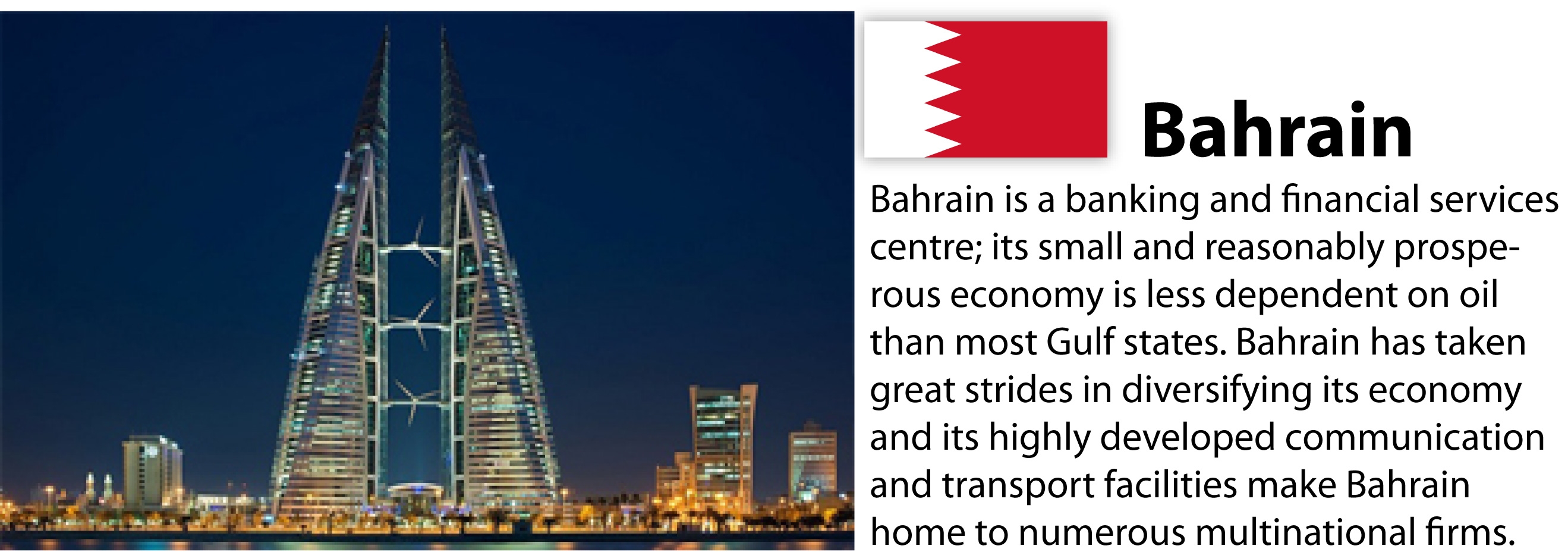
  Bahrain is a banking and financial services centre; its small and reasonably prosperous economy is less dependent on oil than most Gulf states. Bahrain has taken great strides in diversifying its economy and its highly developed communication and transport facilities make Bahrain home to numerous multinational firms with business in the Gulf. Bahrain's economy, however, continues to depend heavily on oil. Petroleum production and refining account for more than 60% of Bahrain's export receipts, 70% of government revenues, and 11% of GDP. Other major economic activities are production of aluminum - Bahrain's second biggest export after oil - finance, and construction. Bahrain competes with Malaysia as a worldwide center for Islamic banking and continues to seek new natural gas supplies as feedstock to support its expanding petrochemical and aluminum industries. The country’s limited oil reserves, which are expected to last only another 10 to 15 years, have led Bahrain to already make significant progress on developing the non-oil sector. Other major segments of Bahrain's economy are the financial and construction sectors. The financial sector contributes around 27 per cent of the kingdom’s GDP, while hydrocarbons contributes around 25 per cent. Manufacturing contributes around 13 per cent. The Kingdom is the main banking hub for the Gulf and a centre for Islamic finance with a total size of $800 billion, which has been attracted by the strong regulatory framework for the industry.   Essential Information Area: 695.25 sq kmPopulation: 1.3 millionCapital: Manama Principal Towns: Muharraq, Jidhafs, Isa Town, Awali, Hidd, Rifaa.Area: 695.25 sq kmPopulation:1.3 millionCapital: ManamaPrincipal Towns: Muharraq, Jidhafs, Isa Town, Awali, Hidd, Rifaa.Languages: Arabic is the official language. English is used widely in business circles.Gross Domestic Product (official exchange rate): $26,5 billion (2012 est)GDP per capita: $20,385 (2012 est.)International Reserves: $5.0 billion (2012 est.)Climate: Tropical Gulf climate with hot summers, mild winters and high year-round humidity. The annual average rainfall is only some 70 mm.Currency: 2.64 US Dollar (USD) = nearly 0.377 Bahraini Dinar (BHD)           Visa Requirements: No visa is required for GCC and British nationals. Other travellers must obtain entry visas in countries where there is a Bahraini consulate, these can then be extended locally. Travellers with an onward reservation may obtain a 72-hour transit visa at the point of entry. Bahrain National Day 16 December Current local time  Weather Bahrain Diplomatic representation in Switzerland  

Comoros

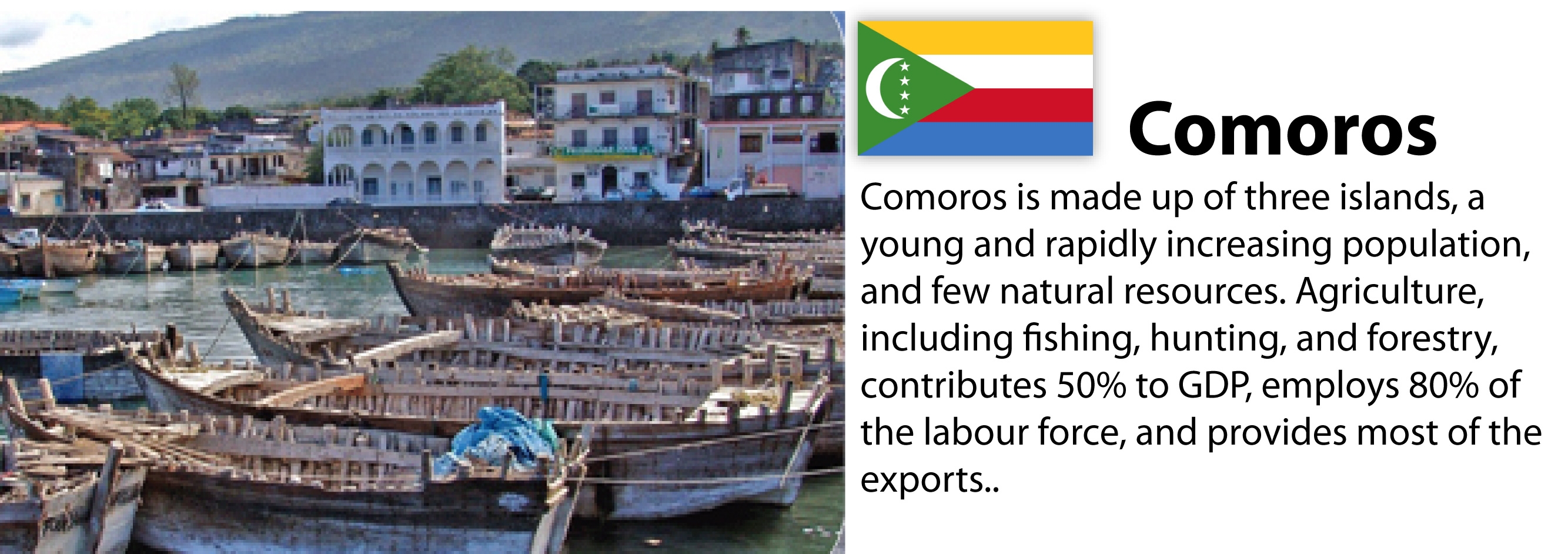
  Comoros is made up of three islands that have inadequate transportation links, a young and rapidly increasing population, and few natural resources. The low educational level of the labour force contributes to a subsistence level of economic activity, high unemployment, and a heavy dependence on foreign grants and technical assistance. Agriculture, including fishing, hunting, and forestry, contributes 50% to GDP, employs 80% of the labour force, and provides most of the exports. Export income is heavily reliant on the three main crops of vanilla, cloves, and ylang-ylang; and Comoros' export earnings are easily disrupted by disasters such as fires. The country is not self-sufficient in food production; rice, the main staple, accounts for the bulk of imports. The government is struggling to upgrade education and technical training, privatize commercial and industrial enterprises, improve health services, diversify exports and promote tourism. Remittances from 150,000 Comorans abroad help supplement GDP.  The international donor community currently plays a modest role in the country’s development. According to the OECD statistics, Comoros received approximately US$25 million in development assistance in 2005. France was by far the largest donor contributing almost $17 million followed by UN agencies (including the World Bank) with over $7 million and the EC with over $4 million. Further, the economy is also significantly dependent upon remittances from the estimated 150,000-strong Comorian Diaspora in France and elsewhere. Economic development in the past two decades has been hindered by a combination of recurrent political crises, macro-economic imbalances, and external shocks. A gradual recovery of the economy is observed since 2008. Real GDP is driven by agriculture and services increased by 0.6% in 2008, 1.1% in 2009 and 2.1% in 2010.   Essential Information      Area: 2,170 sq kmPopulation:795,000 (July 2011 est.) Capital:MoroniPrincipal Towns:Fomboni, Moutsamoudou, DomoniLanguages: Arabic and French are the official languages while Comoran, a blend of Swahili and Arabic, is also spoken. Gross Domestic Product (purchasing power parity):$872 million (2012 est.) Gross Domestic Product (official exchange rate):$595 million (2012 est.) GDP per capita: $1,300 (2012 est.) Reserves: 6.2 months of imports of goods and services (2009 est.)Climate: The coast has a moderate climate with temperatures ranging from 13 to 32°C. The summer months of June to September can be hot and humid with daytime temperatures registering between 27 and 32°C; these can be exceeded, for brief periods, when the hot, dry sirocco wind blows from the south. The Sahara desert is hot and arid with daytime temperatures reaching 43°C while night temperatures fall to 10°C or less. Currency: Comoros Franc (KMF) = nearly 0.00281 US Dollar (USD) Visa Requirements: A valid passport and onward/return ticket are required. A three-week entry visa, which may be extended, may be obtained from the airport on arrival. Travellers should obtain the latest details from the nearest Mission of the Federal Islamic Republic of the Comoros.   Comoros' National Day 6 July   Current local time  Weather Diplomatic representation of Comoros in Switzerland  

Djibouti

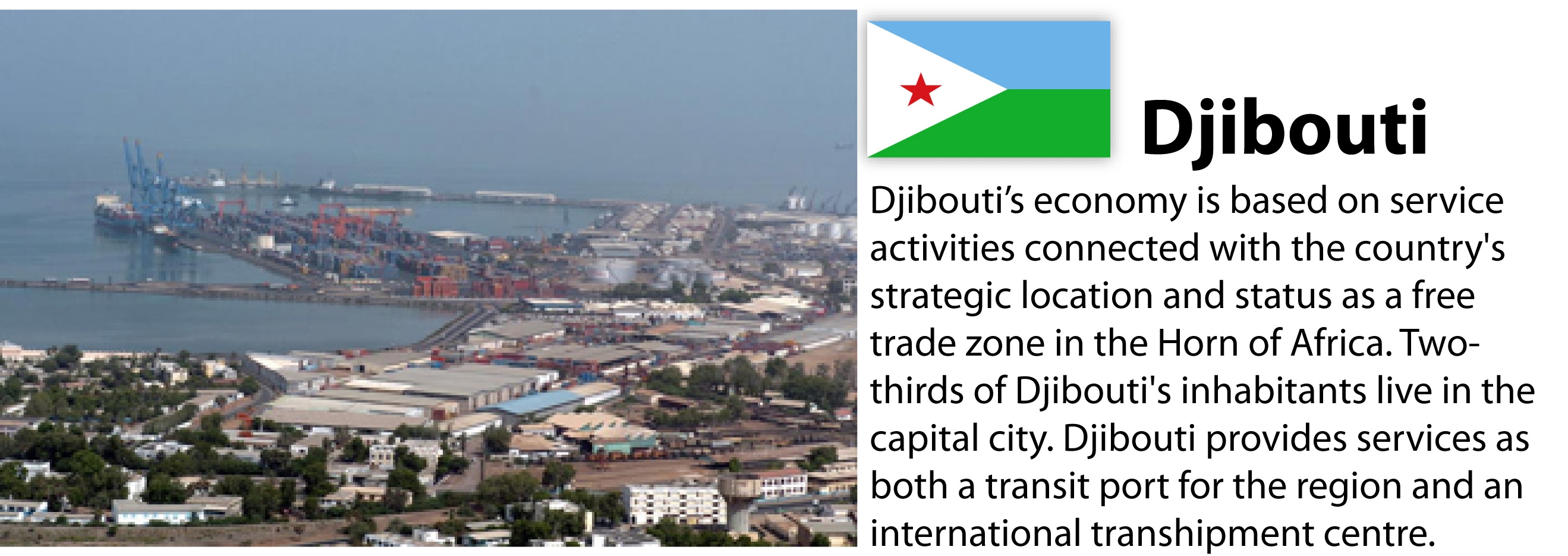
  Djibouti’s economy is based on service activities connected with the country's strategic location and status as a free trade zone in the Horn of Africa. Two-thirds of Djibouti's inhabitants live in the capital city; the remainder are mostly nomadic herders. Djibouti provides services as both a transit port for the region and an international transhipment and refuelling centre. Imports and exports from landlocked neighbour Ethiopia represent 70% of port activity at Djibouti's container terminal. Djibouti has few natural resources and little industry. The nation is, therefore, heavily dependent on foreign assistance to help support its balance of payments and to finance development projects.  The Djiboutian economy has benefited from huge investment in the transport sector namely; port investment, construction and banking sector during the last years. Foreign direct investment (FDI) as well has registered a positive evolution in the last ten years. With the aim of strengthening Djibouti's position as a hub for trade, logistics and related services, as well as a provider of financial services, several road corridors were opened or renovated in 2010. Nevertheless, the economy remains little diversified and highly dependent on port operations in the tertiary sector. This accounts for 76% of GDP, while the primary sector contributes a mere 3.9%. The country depends almost entirely on imports for its food supply. Domestic agricultural production covers only 10% of the country's food needs.  Djibouti is at the crossroads of major sea routes for trading oil and other goods, and wants to become a hub for commercial, logistical and financial services for the Gulf of Aden countries. The government has launched a 4.3 billion US dollar (USD) investment programme, and in 2012, funding was obtained to build new port facilities for salt and potassium exports.  The government is also drafting a long-term development strategy called Vision 2035, and a study is being done of which leading sectors could diversify the sources of national growth and create jobs. Essential Information     Area: 23,200 sq km Population: 792,198 (2013 est.) Capital: Djibouti Principal Towns:Dikhil, Tadjoura, Obock Languages: Arabic and French are the official languages. Afar, Amharic and Somali are also widely spoken. Gross Domestic Product: $1.4 billion (2012 est.) GDP per capita: $1,767 (2012 est.) GDP per capita (PPP): $2,700 (2012 est.) Gross Official Reserves: $0.2 billion (2012 est). Climate: Very hot and arid from April to August with average temperatures of 32°C but reaching 45°C. October through March is slightly cooler with occasional light rain. Currency: 1.00 USD ≈ 179.7 Djiboutian Franc (DJF), 1.00 DJF = 0.00556 USD. Visa requirements: Visas are required by all visitors, except French nationals, on short stay visits. Ten-day visas are available on arrival for US and EU nationals - an onward ticket is also required.    Djibouti National Day, 27 June. Current local time  Weather Diplomatic representation of Djibouti in Switzerland  

Egypt

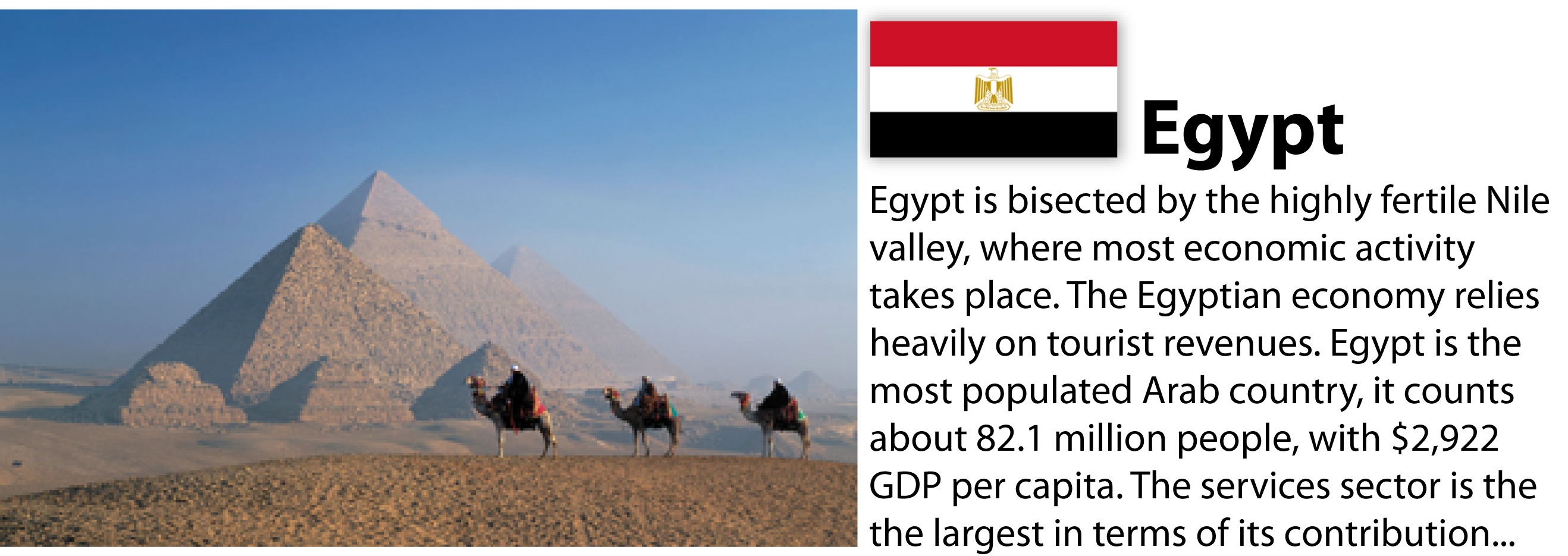
  Egypt is bisected by the highly fertile Nile valley, where most economic activity takes place. The Egyptian economy relies heavily on tourist revenues. Egypt is the most populated Arab country, it counts about 82.1 million people, with $2,922 GDP per capita. The contribution of the Egyptian economy is about 0.3% of the emerging markets index MSCI. Egyptian population is rather young. The aged 15 years or less, about 34%, and the age group of youth from 15-35 years old about 35%.  The people who represent the workforce in the category of 15-65 years old represent 62%, which requires a clear map to take advantage of the power work in economic activity. The services sector is the owner of the largest share in terms of its contribution to the GDP of the acquisition of more than 50%, while the contribution of industry and agriculture, two sectors that offers a real job opportunities, permanent and constitute a measure of value added is 37.7% and 13.1% subsequently. The rising contribution of services sector because of its education and health services, provided by public institutions. On the other hand, the tourism sector is considered historically a main source of Egypt’s national income with some 12 million tourists visiting Egypt and spending about $11 billion annually.Egypt’s economy is still suffering from a severe downturn and the government faces numerous challenges as to how to restore growth, market and investor confidence. Political and institutional uncertainty, a perception of rising insecurity and sporadic unrest continue to negatively affect economic growth. Real GDP growth slowed to just 2.2 percent year on year in October-December 2012/13 and investments declined to 13 percent of GDP in July-December 2012. The economic slowdown contributed to a rise in unemployment, which stood at 13 percent at end-December 2012, with 3.5 million people out of work. Foreign exchange reserves have continued to decline to reach about 3 months of imports. Essential Information  Area: 1,002,000 sq kmPopulation: 85,3 Million (2012 est.) Capital: CairoPrincipal Towns: Alexandria, Tanta, Damietta, Suez, Port Said.Languages: Arabic is the official language; French and English are both widely used, particularly in business circles. Gross Domestic Product: $255billion (2012 est.)GDP per capita: $2,989International Reserves: $15.72 billion Climate: Generally warm and dry from November to March although day temperatures can rise to over 38°C. April to October can see periods of intense heat in Cairo and Upper Egypt. Rainfall is limited to the northern, coastal region. A hot and dusty desert wind, the Khamaseen, blows in April/May and August/September.Currency: 1$ ≈ 6.8 Egyptian Pound (EGP) DEMOGRAPHYAge Distribution (2012 est.) 0-14 years: 32.5% 15-24 years: 18.2% 25-54 years: 38.1% 55-64 years: 6.5% 65 years and over: 4.7%  Population Growth 1.92% (2012 est.) Education71.4% of the total population age 15 and over can read and write  NATURAL RESOURCESFossil FuelPetroleum, natural gas MineralsIron ore, phosphates, manganese, limestone, gypsum, talc, asbestos, lead, zinc  Hydro-electricAssuan and Nasser Dams Visa: All visitors must be in possession of a valid passport and a visa. Travellers should ensure that their passports extend for three months from the date of the visa being issued. Where this date may be exceeded intending visitors are advised to renew their passports beforehand as persons found with non-registered passports can be liable to a £E 20 fine. One-month tourist and seven-day transit visas are available at Egyptian ports, airports and frontier posts; even so it is preferable to obtain visas before travelling.  National Day 23 July. Current local time  Weather Diplomatic representation of Egypt in Switzerland

Doing business

Egypt Accelerates Investment Reforms and Prepares New State-Owned Company Listings

Egypt’s Minister of Investment and Foreign Trade, Mohamed Farid Saleh, announced that the government plans to intensify efforts to improve the business environment and reduce bureaucratic obstacles, while preparing to li…

Opinion

4th Industrial Revolution, but for whom?

  By Ayman Abualkhair   (النسخة العربية) Nowadays, much is being said on the 4th Industrial revolution. The world has gone through three industrial revolutions during the last two centuries. The First Indus…

Finance

World Bank Group Allots US$200 Million for Road Repairs in Lebanon

  World bank   (Version Française) (النسخة العربية)    The World Bank Group has earmarked US$200 million for upgrading Lebanon’s road network, seen as a risk to public safety as well as an impediment to urban-rural …

Diplomatic corner

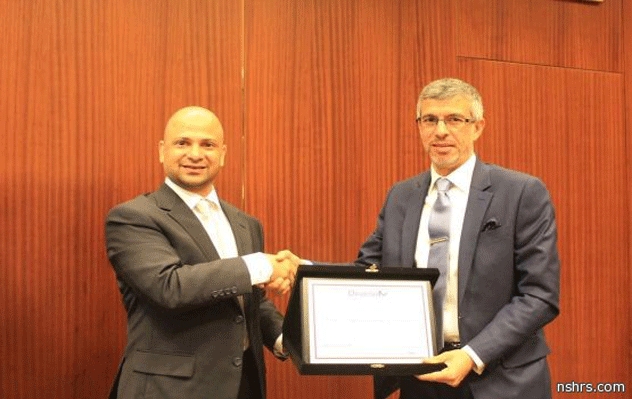
وفد دايركشن المعرفية يزور جنيف ويكرم السفير السعودي الجديد لدى منظمة التجارة العالمية الدكتور عبد العزيز بن محمد الواصل

  نقلا عن موقع "نشر"   قام وفد رحلة دايركشن المعرفية والثقافية بزيارة الى جنيف في السادس والعشرين من شهر كانون الثاني/ يناير من هذا العام حيث التقي سعادة السفير الدكتور عبد العزيز بن محمد الواصل المندوب الدائم لوفد ال…

Reports

Algeria Launches 2026 Oil and Gas Bid Round to Attract New Foreign Investment

22 Apr 2026

Algeria officially launched a new licensing round for the oil and gas sector, titled "Algeria Bid Round 2026." The move aims to bolster production and attract Foreign Direct Investment (FDI) into the energy sector, the country’s primary source of foreign currency. The bid round includes seven exploration blocks stretching across fields in Ogla, Illizi, Touggourt, and El Bayadh. These areas are believed to hold significant oil and natural gas reserves, positioning them among the most prominent investment opportunities in North Africa this year. This initiative is part of a broader government strategy to revitalize the energy upstream sector and solidify Algeria’s position as a regional gas hub, particularly amid rising global demand for energy sources following the supply chain disruptions of recent years. According to the Algerian Ministry of Energy, the process will enter a technical phase in June 2026, during which project data will be opened to international firms, followed by briefing sessions and technical consultations. Final bids are expected in November 2026, with contracts slated for signing in January 2027. These will include production-sharing contracts (PSCs) or partnership agreements with the state-owned oil giant, Sonatrach. Through this round, Algeria seeks to draw new global energy players into the local market at a time when it is working to scale up production levels and improve the investment climate in a sector that serves as the backbone of the national economy. Its substantial gas reserves further cement its role as a key player in the European and Mediterranean energy markets. The move also highlights a gradual shift in Algeria’s investment policy—moving from traditional reliance on national companies toward a model more open to foreign capital. By offering flexible contractual incentives via production-sharing models, the state aims to mitigate risks for international investors and incentivize entry into high-cost exploration projects. Ultimately, the "Algeria Bid Round 2026" reflects a clear effort to reposition Algeria on the global energy investment map by linking untapped natural resources with foreign capital and technology, amidst a wide-scale reshaping of global energy supply and demand dynamics.

Egypt Ranks Third Regionally in Investment Attractiveness: Insights into Fitch’s FDI Inflows Report

A report by Fitch Ratings—reviewed by the Egyptian Cabinet’s Information and Decision Support Center (IDSC)—revealed that Egypt ranked third among 18 markets in the Middle East and North Africa (MENA) region in terms of investment openness. Globally, Egypt secured the 27th position out of 202 countries, a metric reflecting a relative improvement in its standing on the global investment map. The report indicates that this ranking reflects Egypt's capacity to attract Foreign Direct Investment (FDI) inflows, bolstered by a diversified investment landscape. Key sectors include oil and gas, automotive manufacturing, ICT, food industries, renewable energy, infrastructure, and financial services. This sectoral diversity demonstrates the breadth of the Egyptian economy and its multiple investment catalysts, moving away from reliance on a single sector or limited economic axis. Fitch attributes the improvement in investment flows to several structural factors, including economic growth, a strategic geographic location linking Asia, Africa, and Europe, low labor costs, and a wealth of human talent. This is further supported by a massive domestic market, abundant energy sources, and a tourism sector that remains a long-term draw for capital. Additionally, the report notes the increasing role of Gulf-based financing, which has become a primary source of foreign capital in Egypt in recent years. In the same vein, the report suggests that a flexible exchange rate policy, in alignment with International Monetary Fund (IMF) recommendations, is expected to support the stability of foreign currency inflows in the short and medium term by enhancing the economy’s resilience to external shocks and boosting investor confidence. Egypt aims to attract approximately $60 billion in FDI between 2026 and 2030—a target the report deems relatively achievable, given that annual inflows typically range between $9 billion and $11 billion, excluding exceptional mega-projects. The report contrasts this figure with total investment flows into the African continent, which often remain below $60 billion annually, highlighting the scale of Egyptian ambition relative to its regional context. The report also highlights Egypt's position as a premier investment destination in North Africa, with growing interest from multinational corporations in the industrial, pharmaceutical, and electronic sectors. It notes that the Egyptian government has taken significant steps in recent years to enhance the investment climate, including the implementation of the unified approval system for investment licenses, known as the "Golden License." This system allows for the establishment and operation of projects within a relatively short timeframe of approximately 20 working days, reducing administrative hurdles and accelerating investment entry. The legislative framework has been further strengthened by Investment Law No. 72 of 2017 and its subsequent amendments, which provide tax incentives and guarantees for investors, including facilitating the repatriation of profits and ensuring equality between local and foreign investors. Recent amendments under Law No. 160 of 2023 introduced further incentives, alongside efforts to improve the geographical distribution of investments across the country. Regarding future sectors, the report points to a surge in interest in renewable energy. Fitch expects Egypt to lead the region in solar and wind capacity growth, driven by reforms initiated in 2014 that allowed private sector participation in electricity production and the gradual reduction of energy subsidies. The government aims to increase the contribution of renewable energy to 42% of total electricity production by 2030, a goal currently being met ahead of schedule. The report also sheds light on the expansion of investments in coastal development and tourism, particularly in the North Coast region, alongside the continued importance of the real estate sector, which contributes roughly 20% of GDP, reflecting its deep integration into the macroeconomy. Fitch confirms that Egypt possesses the largest stock of FDI in North Africa. The United Arab Emirates emerged as the largest investor in the country during 2024 and 2025, followed by the United States, the United Kingdom, Italy, Saudi Arabia, and Kuwait, reflecting a diversified base of foreign capital sources. In summary, the report presents a dual image of Egypt as an investment hub: on one hand, there is clear progress in the legislative framework, attractive sectors, and capital flows. On the other hand, actual performance remains tied to the economy's ability to translate these structural advantages into sustainable, long-term inflows within a highly volatile regional and international environment.

Saudi Arabia and Switzerland: A Strategic Partnership from Historical Roots to the Horizons of Vision 2030

The bilateral relationship between the Kingdom of Saudi Arabia and the Swiss Confederation represents a continually evolving partnership. Grounded in a long history of mutual understanding, it has now entered a new phase characterized by strategic depth, particularly in light of the ambitious Saudi Vision 2030. While Switzerland is a global hub for innovation, finance, and technological expertise, Saudi Arabia stands as the region's largest economy and a gateway for monumental developmental transformation. This confluence of interests creates a vital intersection for collaboration in the fields of entrepreneurship, sustainability, and technology. Historical Foundations of Diplomatic Relations The institutional connection between the two countries dates back many decades, with Switzerland recognizing the newly established Kingdom of Saudi Arabia in 1927. However, formal diplomatic relations were only established in 1956. This relationship saw a significant economic turning point with the formation of the Saudi-Swiss Joint Economic Commission (JEC) in 1975. Since then, the JEC has served as the primary platform for enhancing cooperation in economic, trade, investment, scientific, and technical domains. The relationship has been strengthened by high-level reciprocal visits, underscoring Switzerland's role as a trusted partner, even playing a crucial diplomatic role in representing Saudi and Iranian interests in 2017. Analysis of Economic Relations and Investment Opportunities The Kingdom of Saudi Arabia is currently ranked as Switzerland's second most important trading partner in the Middle East (after the UAE). The total trade volume between them amounts to approximately CHF 6.8 billion (including gold), with Swiss exports accounting for over CHF 6 billion of this figure. Furthermore, the cumulative investment of Swiss companies in Saudi Arabia reached about CHF 1.41 billion by the end of 2022. While this economic volume is an indicator of mutual trust, the biggest driver for future growth is Vision 2030. This unprecedented economic shift has offered vast opportunities for numerous Swiss companies to participate in "Giga-projects" such as NEOM, Qiddiya, and the Riyadh Expo 2030. This direction was affirmed during the recent 14th Joint Economic Commission meeting, where discussions emphasized the need to finalize bilateral legal agreements, such as improving the implementation of the Free Trade Agreement between EFTA states and the GCC, and expediting the conclusion of a new Investment Protection Agreement (IPA). Partnership in Transformation Pillars: Technology, Sustainability, and Entrepreneurship The new Saudi-Swiss partnership is focused on three main pillars, as the Kingdom seeks to leverage Switzerland’s extensive expertise to accelerate its non-oil economic diversification. 1. Technology and Innovation Switzerland is a world leader in technological education and innovation, hosting institutions like the Swiss Federal Institute of Technology in Zurich (ETH Zurich), which is globally prominent in areas such as Artificial Intelligence and Robotics. This expertise aligns perfectly with Saudi Arabia's ambition to become a global technology power, especially after its leadership in global digital development indices. Technological cooperation is evident in several forms: AI and Digital Transformation: Specialized Swiss companies are seeking opportunities to integrate solutions in AI, Blockchain, and even the Metaverse into vital Saudi sectors. Digital Infrastructure: Swiss firms are participating in building the advanced digital infrastructure that supports projects like NEOM, which relies entirely on cutting-edge technologies. 2. Sustainability and CleanTech Sustainability holds paramount importance in the partnership, particularly with Saudi Arabia's adoption of ambitious climate initiatives, including the NEOM Green Hydrogen projects, set to be the world's largest of their kind. CleanTech Forum: The two nations hosted the First Saudi-Swiss CleanTech Forum in 2023, gathering Swiss SMEs that offer innovative solutions for climate change mitigation. Knowledge Transfer: Saudi Arabia benefits from the "bottom-up" Swiss approach to innovation, which focuses on funding basic research in universities and supporting start-ups in renewable energy and environmental solutions. 3. Entrepreneurship and Business Localization The Kingdom views the private sector, including Swiss companies, as an essential engine for achieving development goals, specifically in job creation and economic diversification. Figures indicate that Saudis hold a positive perception regarding the availability of entrepreneurial opportunities and the necessary skills to launch a business. The Localization Challenge: As the market grows more attractive, Saudi Arabia has introduced new policies to ensure value localization.The most prominent is the Regional Headquarters (RHQ) program, which requires foreign companies to move their regional headquarters to the Kingdom to secure government contracts. Additionally, the Economic Participation Policy (EPP) has been adopted, mandating a local economic participation of at least 35% in certain public procurement contracts. Swiss Response: Despite the complexity of these rules, about ten Swiss companies have already responded by relocating their regional headquarters to the Kingdom.This reflects the strategic importance they attach to the opportunities in the Saudi market. Furthermore, cooperation in the hospitality and tourism sector through partnerships for qualifying Saudi tourism competencies is evidence of Swiss expertise penetrating new sectors. Future Outlook and Strategic Trajectory The relationship between Saudi Arabia and Switzerland is currently at its strongest point, having evolved from a traditional trade partnership into a strategic alliance aimed at building the future. Vision 2030 serves as the driving force connecting the robustness of the Swiss economy with Saudi Arabia's ambitious push for diversification. While the Kingdom imposes regulatory challenges (such as RHQ and EPP) to ensure value localization, the fields of CleanTech, Artificial Intelligence, and entrepreneurship remain ideal areas for deepening this cooperation, establishing it as a model for partnership between a developed European economy and an ascending regional power.

UAE's Reno, a Home Renovation Tech Platform, Secures $4 Million to Fuel GCC Expansion

Reno, a technology platform based in the UAE specializing in home renovation and interior design, has successfully closed a $4 million funding round, comprised of a mix of equity and debt. The funding is specifically aimed at building the region's first end-to-end operating system for renovation processes. The round was led by prominent investors, including Sanabil 500, Hub71, Plus VC, Zero 100 VC, FlyerOne Ventures, Sandstorm VC, AngelSpark, and the Swiss Founders Fund. Leading Home Renovation with AI Technology Founded in 2024 by Marc Michel, Amr Hosny, and Farah Karabeg, Reno positions itself as a comprehensive, all-in-one platform for interior design and renovation across residential and commercial projects. The current funding will support the launch of Reno’s new app in early 2026, which is set to introduce innovative features, including: Real-time AI-powered design. Instant budget estimates. An Intelligent Materials Engine, providing customers with complete clarity from the very start of their renovation journey. A Comprehensive and Transparent Business Model Unlike traditional renovation services, Reno integrates all stages of the renovation process into a single platform, covering design, project management, contractor oversight, and financing options. One of its signature offerings is the "Renovate Now, Pay Later (RNPL)" financing option. This model provides a transparent, structured, and fully supervised renovation experience, giving homeowners and property investors unmatched control and visibility through AI-driven workflows and transparent, milestone-based processes. Control and Growth for Investors: Ibrahim Shami, CEO and Co-founder of Seraya (one of the fastest-growing short-term rental operators in the UAE), leveraged the RNPL financing options to renovate multiple units without paying upfront. Reno's support helped him double his portfolio's renovation pace from two to four apartments per month, effectively turning a renovation "bottleneck into an opportunity to expand faster and smarter." Reducing Stress for Families: For a customer like Camillo Schobesberger, a busy professional, the platform-driven approach transformed his renovation into a smooth, structured experience thanks to daily updates, clear budget oversight, and milestone-linked payments. He noted that the platform "made the renovation journey smooth for my family, minimising disruption," and the carefully managed upgrades "increased my property value by nearly 40%." Expansion Outlook Marc Michel, Co-founder and CEO of Reno, stated: "Our goal is to make home renovations as seamless and transparent as possible." With the new $4 million funding, Reno plans to expand its geographical footprint across the GCC region, scale its technology capabilities, and continue to refine the renovation experience. By leveraging innovation and data-driven workflows, Reno is redefining how renovations are managed, helping clients save time, reduce stress, and maximize their property value.

TERN Group Raises $24 Million to Expand Partnerships Across Europe and the Gulf

TERN Group, an AI-powered global workforce-mobility platform for healthcare professionals headquartered between the UK and the UAE, has secured $24 million in a Series A funding round, bringing its total capital raised to $33 million. The round was led by Notion Capital (UK) with participation from EQ2 Ventures (UAE), RTP Global, LocalGlobe, Leo Capital, Presight Capital, and investor Tom Stafford, co-founder of DST Global. Founded in 2023 by Avinav Nigam and Krishna Ramkumar, TERN trains, certifies, and places healthcare professionals from 13 countries, cutting international hiring timelines from 6–12 months to under 10 weeks. The new funds will be used to: Scale the company’s AI platform. Enhance training and compliance infrastructure. Strengthen partnerships with healthcare providers across the Gulf region while supporting growth in Europe and the UK. CEO Avinav Nigam emphasized TERN’s mission to make global healthcare hiring faster and more transparent, noting the UAE’s rapidly growing demand for skilled professionals—healthcare spending there is projected to exceed $50 billion by 2029. The platform already serves more than 650,000 healthcare professionals and over 100 healthcare organizations, offering end-to-end solutions including résumé analysis, compliance tracking, and initial interviews, with a support team that assists candidates with training, relocation, and cultural integration. Notion Capital highlighted TERN’s ability to address the global shortage of healthcare workers by combining AI-driven efficiency with strict regulatory compliance, making it a trusted partner for health systems in the UK, UAE, Germany, and beyond. With this investment, TERN Group plans to accelerate expansion in the Gulf and deepen integration with regional health systems, building a sustainable workforce infrastructure that enables hospitals and governments to meet rising healthcare demand efficiently and confidently.

About Us

Enjoy the power of entrepreneurs' platform offering comprehensive economic information on the Arab world and Switzerland, with databases on various economic issues, mainly Swiss-Arab trade statistics, a platform linking international entrepreneurs and decision makers. Become member and be part of international entrepreneurs' network, where business and pleasure meet.


Contact Us

Please contact us : 

Cogestra Laser SA

144, route du Mandement 

1242 Satigny - Geneva

Switzerland