When the World Chokes: The Closure of Hormuz and the Spectre of Global Stagflation
by: Ayman Abualkhair
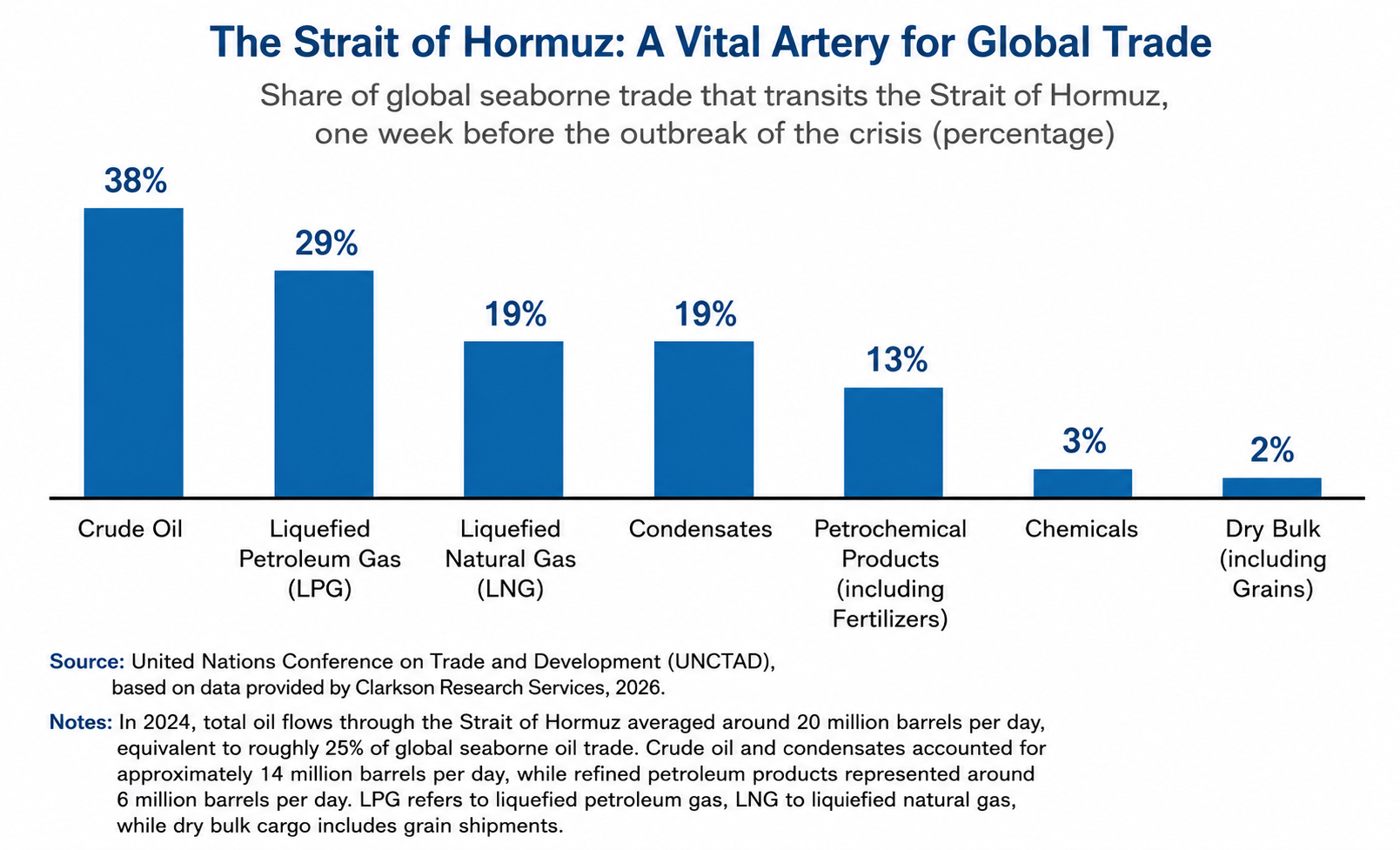
The Strait of Hormuz is one of the world’s most critical maritime chokepoints. Roughly a quarter of globally traded seaborne oil—equivalent to nearly 20m barrels a day—passes through this narrow waterway, alongside substantial volumes of liquefied natural gas and fertilisers. The continuing military escalation in the region has severely disrupted shipping through the Strait, triggering a chain reaction that extends far beyond the Gulf itself. The shock has spread across energy markets, maritime transport and global supply chains, creating disruptions that now stretch from Asian factories to American consumers, and from fuel markets to food prices.
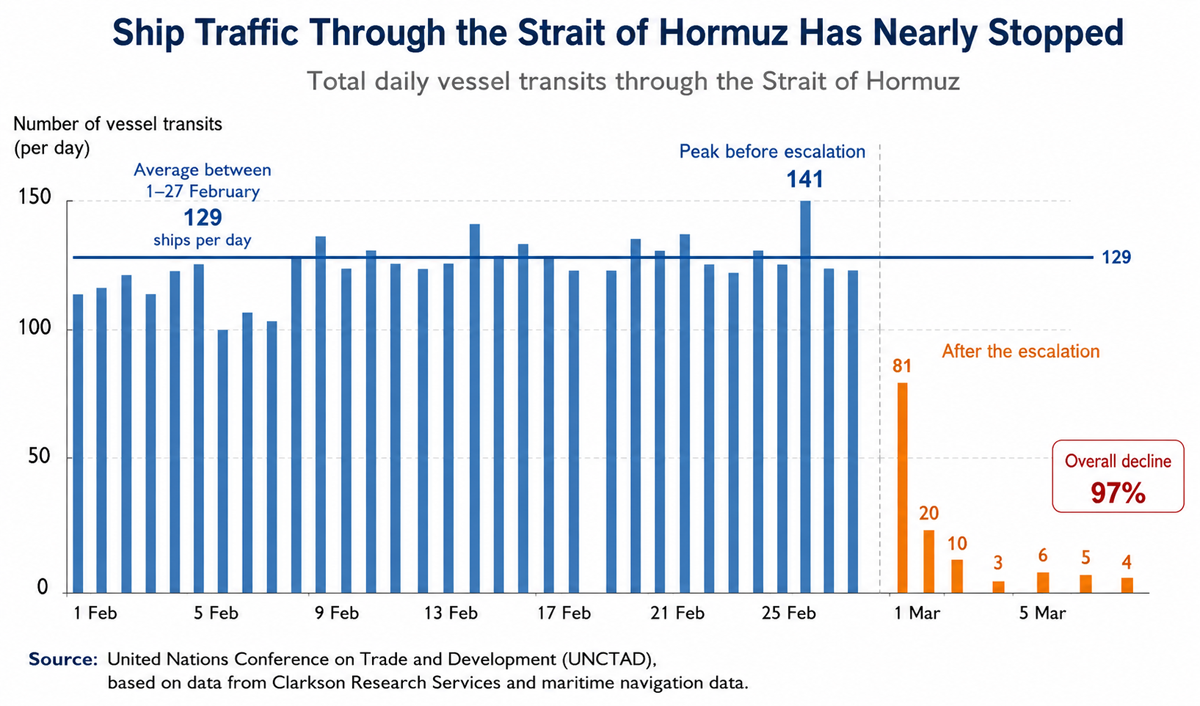
What for decades had been treated as an unlikely geopolitical scenario has abruptly become an economic reality. Since the outbreak of the American–Israeli war against Iran in late February 2026, global trade has entered a new era of uncertainty. Flows through the Strait have collapsed almost completely, prompting the International Energy Agency (IEA) to describe the crisis as “the largest disruption in the history of the global oil market.”
As shipments stalled, the market suddenly lost a vast portion of global supply at a time when oil markets were already heading towards a structural deficit. Prices reacted immediately. Brent crude climbed above $120 a barrel, while major financial institutions and energy analysts warned that a prolonged closure could push prices towards $150 during the second half of 2026.

Yet the real danger lies not only in oil prices themselves, but in the structure of the modern global economy. Energy is no longer merely a consumer commodity; it has become a fundamental input in every stage of production, transportation and manufacturing. As a result, any sharp rise in energy prices rapidly feeds into broader inflation across other sectors, including fertilisers and transport—ranging from freight rates and marine fuel costs to shipping insurance premiums. Ultimately, this raises food prices and deepens cost-of-living pressures, particularly for the most vulnerable households.
The shock comes at a moment when many developing economies are already struggling with debt-servicing burdens, shrinking fiscal space and limited capacity to absorb further price shocks. While the overall global economic impact will depend largely on the duration and scale of the disruption, the current crisis underlines the importance of closely monitoring the economic consequences of the war, especially for the world’s most fragile economies.
The world has, of course, experienced similar spillovers before. Both the COVID-19 pandemic and the outbreak of the war in Ukraine demonstrated how disruptions in energy, transport and agricultural inputs can quickly cascade through deeply interconnected global markets.
From Oil to Food: The Next Agricultural Crisis
The consequences of the Hormuz crisis do not stop at energy and industry. Gulf countries also occupy a central position in global fertiliser and agricultural chemical markets. Estimates suggest that nearly 30% of global fertiliser trade—including vital supplies of urea and ammonia—passes through the Strait of Hormuz. As shipping flows have been disrupted, fertiliser prices have surged sharply, threatening agricultural production during one of the most sensitive periods of the global planting season.
The effects are already becoming visible in international food markets. The United Nations Food and Agriculture Organisation (FAO) food-price index has climbed to its highest level in more than three years, driven by rising energy costs, fertiliser shortages and higher prices for vegetable oils. The crisis is therefore evolving from a pure energy shock into a broader food-security challenge, particularly for developing economies that remain heavily dependent on imported food, fertilisers and fuel.
1. From an Energy Shock to a Global Economic Crisis
As the American–Israeli war against Iran intensifies and the Strait of Hormuz effectively turns into a zone of naval and military blockade, the crisis has evolved far beyond a limited geopolitical confrontation. It is now emerging as the largest combined energy and trade shock to hit the global economy since the oil crises of the 1970s. According to data from the International Energy Agency (IEA), shipping flows through the Strait collapsed from roughly 20m barrels per day before the war to close to just 2m barrels per day during March 2026, while substantial portions of liquefied natural-gas exports towards Asia and Europe were severely disrupted.
The shock arrives at an exceptionally fragile moment for the world economy, which is already struggling with slowing growth, historically high levels of public debt and persistent inflationary pressures following years of monetary tightening. For that reason, the current crisis is not simply another cyclical rise in oil prices. It represents a multidimensional structural shock extending from energy into manufacturing, food systems and global trade.
Energy remains the primary transmission channel of the crisis. Oil prices surged above $100 per barrel, while major financial institutions and energy traders warned that a prolonged closure could push prices towards $150–200 in more pessimistic scenarios. Liquefied natural-gas prices also rose sharply as exports from Qatar and the UAE weakened and shipments through Hormuz were disrupted.
Economically, the crisis represents a textbook example of a negative supply shock: prices rise even as supply and output decline, generating broad inflationary pressures. What makes the current episode particularly dangerous, however, is that the shock does not remain confined to energy markets alone. It spreads rapidly through higher transportation, insurance, shipping and production costs, fuelling what economists describe as cost-push inflation.
The effects are already spilling into global industrial supply chains. Disruptions to exports of sulphur, aluminium and fertilisers from the Gulf have increased manufacturing costs, particularly across Asia, which remains heavily dependent on energy and raw materials from the region. Recent reports suggest sulphur prices have risen by more than 50%, while battery, electric-vehicle and electronics industries are beginning to face mounting supply-chain disruptions.
At the same time, the crisis is gradually evolving from an energy shock into a global food shock. Rising fertiliser prices and higher agricultural shipping costs are feeding directly into food inflation. The International Monetary Fund has warned that persistently high oil and fertiliser prices could trigger a new inflationary wave across developing economies, particularly in countries where food and energy account for a large share of household spending.
The Impact on the United States
Despite America’s increased domestic production of oil and gas over recent years, the United States remains far from insulated from the crisis. The American economy is increasingly exposed to what economists describe as “imported inflation”, whereby rising energy and manufacturing costs in Asia feed directly into higher prices for goods entering the US market. Inflation therefore reaches the American economy not only through higher fuel prices, but also through rising costs of imported electronics, automobiles and consumer goods. With petrol prices climbing above $4 per gallon in several states, the crisis has already begun to erode household purchasing power, weaken consumer confidence and weigh on private investment.
The greater danger lies in the possibility that the global economy may be drifting towards a period of stagflation—a toxic combination of high inflation, slowing economic growth and rising unemployment. The International Monetary Fund has already lowered its global growth forecast to around 3.1%, while warning that a prolonged disruption could push world growth closer to 2% under more severe scenarios, with global inflation potentially exceeding 6%.
The burden of the shock, however, is distributed unevenly across the world economy. Asia remains particularly vulnerable because it depends heavily on energy flows through Hormuz, absorbing roughly 84% of the oil and 83% of the natural gas transported through the Strait. This leaves Asian economies especially exposed to supply disruptions and rising production costs, which in turn amplify inflationary pressures across global manufacturing and trade.
In this environment, central banks face an increasingly difficult balancing act. On the one hand, they are under pressure to contain inflation through tighter monetary policy and higher interest rates. On the other, they must support economic activity as global growth slows. This tension between fighting inflation and preventing recession is becoming one of the defining macroeconomic dilemmas of the current crisis.
2. Supply Chains: Critical Yet Fragile
The crisis did not remain confined to energy markets for long. It quickly spread into global supply chains, the backbone of modern international trade. Disruptions in the Strait of Hormuz triggered a sharp rise in maritime transport costs, with oil shipping rates increasing by an estimated 54–72%. Marine fuel prices surged by as much as 100%, while war-risk insurance premiums multiplied dramatically, in some cases reaching nearly $1m per voyage.
In practical terms, this means that the cost of transporting essential goods—from energy supplies to food products—has risen sharply within a very short period of time. As a result, the problem is no longer merely the availability of goods, but increasingly the cost of delivering them. This dynamic is characteristic of supply-side inflationary crises, where rising logistical and production costs feed directly into broader price increases across the economy.
Perhaps most importantly, the crisis has exposed the fragility of the “just-in-time” production model that dominated global manufacturing over recent decades. Once celebrated as a symbol of economic efficiency, the model has increasingly revealed itself to be structurally vulnerable in times of geopolitical disruption. The heavy dependence on tightly synchronised supply chains, concentrated shipping routes and low inventory buffers has left industries across the world far more exposed to external shocks than previously assumed.
The Gulf: Between Opportunity and Vulnerability
At first glance, higher oil prices may appear to be a windfall for Gulf economies. Yet the reality is far more complicated. The closure of the Strait does not merely drive prices higher; it also disrupts the region’s ability to export energy in the first place. Even with alternative routes such as Saudi Arabia’s East–West pipeline, existing bypass infrastructure can replace only a limited portion of the lost flows through Hormuz.
Moreover, a prolonged crisis threatens the wider stability of regional trade and investment. Shipping and insurance costs have surged sharply, while geopolitical risk premiums continue to rise across Gulf markets. The result is a paradox facing the region’s energy exporters: although oil prices are climbing, the broader economic environment is becoming increasingly uncertain, exposing Gulf economies to mounting logistical, financial and geopolitical pressures.
3. Food and Fertilisers: The Delayed Crisis
The impact of the current crisis is no longer confined to energy markets, which represent the immediate shock. It is increasingly spreading into food systems—the delayed but potentially more dangerous phase of the crisis. The Strait of Hormuz is not only a vital corridor for oil shipments; it also carries nearly a third of global seaborne fertiliser trade, particularly urea, which accounts for roughly 67% of these flows.
The connection between energy and food is crucial. Higher gas prices raise the cost of fertiliser production, which in turn increases agricultural production costs and ultimately feeds into higher food prices worldwide.
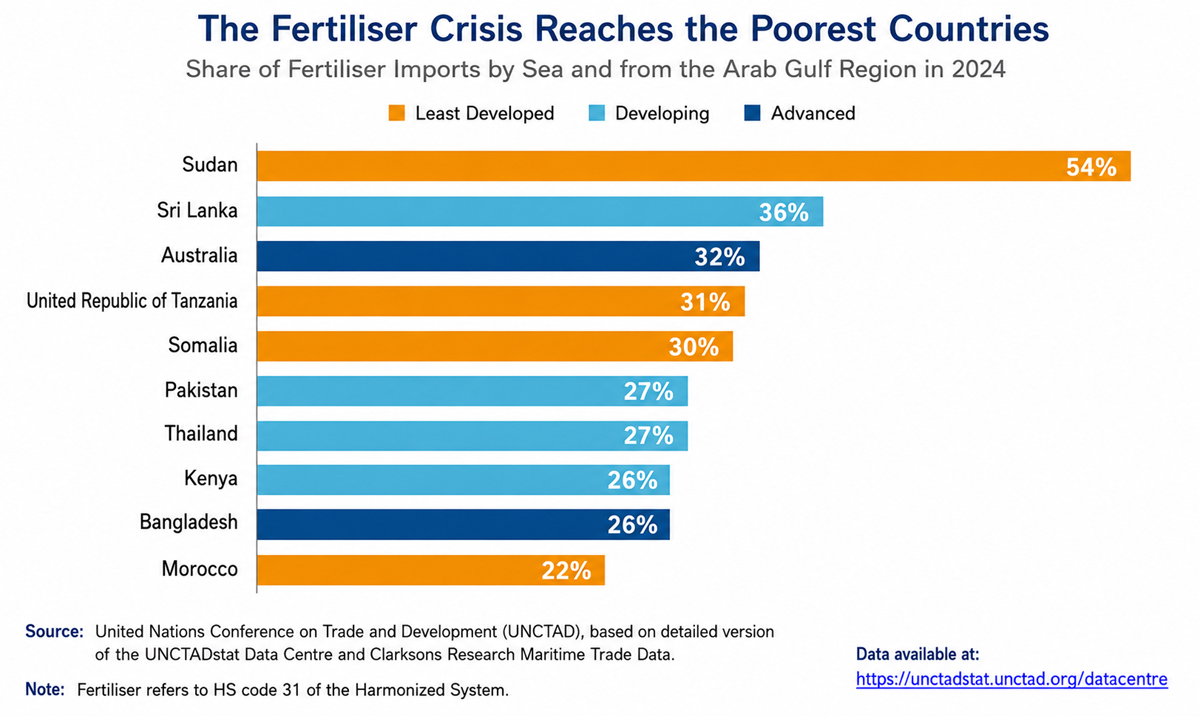
The risks are particularly acute for developing economies that depend heavily on fertiliser imports from the Gulf. Gulf-sourced fertilisers account for approximately:
54% of Sudan’s fertiliser imports
36% of Sri Lanka’s
31% of Tanzania’s
30% of Somalia’s
In these countries, rising prices are not merely an inflationary concern. They represent a direct threat to food security itself, with growing risks of rising poverty, social instability and economic distress.
4. Financial Markets and Macroeconomic Risks: The Crisis Spreads to Global Finance
As the American–Israeli war against Iran intensified and the Strait of Hormuz effectively became a zone of near-total naval blockade, the crisis gradually spread from energy markets into global financial markets. What began as an oil shock is increasingly evolving into a broader source of financial and economic uncertainty. Investors have started aggressively repricing risk across global markets. Sovereign-bond yields in many emerging economies have risen sharply, while risk spreads widened as geopolitical tensions and fears of slower global growth combined with persistent inflation unsettled investors. At the same time, markets witnessed a classic “flight to safety”, with large capital flows moving towards the US dollar, American Treasury bonds and gold, at the expense of riskier assets and emerging markets. Several currencies weakened significantly, while volatility across global financial markets increased markedly.
The situation is particularly dangerous because the current crisis arrives at a time when global interest rates remain elevated after years of aggressive monetary tightening by central banks attempting to contain inflation. As energy prices rise and supply chains weaken once again, markets increasingly fear a renewed inflationary wave, potentially forcing central banks—especially the US Federal Reserve—to keep interest rates higher for longer despite slowing economic growth. This creates an exceptionally fragile financial environment, particularly for heavily indebted developing economies, where rising borrowing costs and weakening currencies place mounting pressure on public finances and foreign-exchange reserves, increasing the risk of financial distress or sovereign-debt crises should the conflict persist.
5. The Economic Impact of Military Escalation on the Arab Region
According to estimates by the United Nations Development Programme (UNDP), the military escalation in the Middle East extends far beyond disruptions to trade and energy markets. It is triggering a broad economic and social shock across the Arab world. UNDP projections suggest that regional economies could suffer losses ranging from 3.7% to 6% of GDP, equivalent to approximately $120bn–194bn in economic losses—figures exceeding the region’s total economic growth achieved during 2025. Unemployment is expected to rise by roughly four percentage points, with around 3.6m jobs potentially lost and as many as 4m additional people falling below the poverty line.
These estimates reveal the structural fragility of many Arab economies, where even a relatively short geopolitical shock can produce long-lasting consequences for growth, employment and social stability. The effects are also highly uneven across the region. Gulf economies and Levant countries are expected to bear the largest losses due to their exposure to trade disruptions and volatile energy markets, while the sharpest increases in poverty are projected to occur in least-developed Arab economies and parts of the eastern Mediterranean region.
The crisis therefore represents more than a temporary economic setback. It marks a potential turning point in the region’s development trajectory, underscoring the urgent need to rethink existing growth models, accelerate economic diversification and strengthen regional production and trade networks in order to reduce vulnerability to external shocks, particularly those linked to energy markets and global supply chains.

China: Between Vulnerability and Strategic Opportunity
Although China is among the economies most exposed to global energy disruptions because of its heavy dependence on imported oil and gas, the current crisis may simultaneously create important geoeconomic opportunities for Beijing. China possesses vast strategic petroleum reserves and maintains close energy ties with both Russia and Iran, giving it greater relative capacity to secure part of its energy needs compared with several Asian and Western economies. Moreover, rising production and energy costs in Western economies could improve the competitiveness of Chinese industries, particularly in electronics, electric vehicles, infrastructure and lower-cost industrial goods.
At the same time, the crisis may encourage many Asian and developing economies—especially in Southeast Asia, including Indonesia, Malaysia and Thailand—to deepen their economic and trade dependence on China as a lower-cost supplier capable of providing financing, industrial goods and energy access. The disruption may also accelerate the use of the Chinese yuan in regional trade and energy transactions, gradually strengthening Beijing’s financial influence. Nevertheless, these potential gains remain conditional on avoiding a severe global recession, since weaker demand in the United States and Europe would ultimately weigh on Chinese exports and industrial growth.
Conclusion
Viewed in its broader context, the Strait of Hormuz crisis is not merely a temporary disruption in energy markets. It represents a complex structural shock threatening to push the global economy into a more dangerous phase of persistent inflation and stagflationary risk. Simultaneous disruptions to oil supplies and rising transportation costs have created what economists would describe as a “double supply shock”, where prices rise across multiple sectors even as economic activity slows.
This combination of rising costs and weaker growth creates an exceptionally difficult environment for policymakers. Fighting inflation requires tighter monetary policy, yet tighter policy risks deepening the slowdown. Supporting growth, meanwhile, may fuel additional inflationary waves. If disruptions in strategic corridors such as Hormuz persist, today’s inflationary pressures could evolve from a temporary shock into a more durable global inflation regime capable of reshaping the world economy for years to come.
The crisis also arrives before the global economy has fully recovered from earlier shocks, including the pandemic and the war in Ukraine, increasing the risk of slipping into a stagflationary scenario marked by weak growth and rising prices—one of the most dangerous and difficult macroeconomic environments to manage.
More fundamentally, the crisis demonstrates that the global economic model built around maximum efficiency is no longer sufficient to guarantee resilience. Recent shocks have shown that the most efficient systems are not necessarily the most durable, and that excessive dependence on concentrated trade routes or supply chains can rapidly become a strategic vulnerability. As a result, governments and businesses alike are increasingly being forced to rebalance efficiency with resilience, openness with strategic protection and globalisation with economic security.
Europe now faces mounting industrial pressure from rising energy costs. The United States confronts growing imported inflation as higher production costs in Asia feed into consumer prices. China, despite its vulnerabilities, may attempt to transform the disruption into an opportunity to expand its geopolitical and economic influence. Meanwhile, the Arab world remains both central to the crisis and among its most exposed regions.
For oil-exporting Arab economies, higher energy prices provide temporary gains, yet these are offset by export disruptions, rising insurance and shipping costs and growing geopolitical instability. Energy-importing Arab economies face even harsher pressures through inflation, food insecurity and deteriorating fiscal conditions. Estimates suggest the Arab region could suffer losses ranging from 3.7% to 6% of GDP—equivalent to roughly $120bn–194bn—alongside the loss of around 3.6m jobs and up to 4m additional people falling into poverty.
Ultimately, the Hormuz crisis is not simply an oil crisis. It is a test of the resilience of the global economic system itself and a reminder that geopolitical instability in an interconnected world eventually affects everyone.
Recommendations
The Hormuz crisis makes clear that the world has entered a new era in which geopolitical shocks are no longer isolated regional events but systemic global risks capable of destabilising the entire international economy. This underlines the urgent need for a more balanced and cooperative global economic order based on partnership between advanced and developing economies alike, and on respect for the economic interests of all peoples rather than the deepening of geopolitical rivalries. The current crisis has shown how disruptions in energy, trade and food systems in one region can rapidly evolve into global inflation, financial instability and slowing growth across every continent. Strengthening international cooperation in energy security, food supply chains, trade, investment and technology therefore becomes essential not only for economic stability but for sustainable global development itself.
The crisis also demonstrates that prolonged wars and geopolitical confrontations do not merely punish poorer or more fragile nations. Their effects inevitably spread to major economies, financial markets and living standards around the world. Inflation, rising food and energy prices and slowing growth recognise no borders. Any prolonged breakdown in global stability ultimately weakens all economies regardless of their relative wealth or military power. This is why diplomacy, dialogue and mutual respect among nations must once again become central pillars of international economic stability. The world today requires not only crisis management, but a broader vision based on cooperation, shared development and reducing inequalities between rich and poor countries. Lasting stability cannot emerge in a world increasingly shaped by fragmentation, conflict and widening economic divides.
This article draws primarily on:
- “Disruptions in the Strait of Hormuz and Their Implications for Global Trade and Development”, published by the United Nations Conference on Trade and Development (UNCTAD), 10 March 2026.
- “Military Escalation in the Middle East Could Erase More Than a Year of Economic Growth in the Arab Region”, United Nations Development Programme (UNDP), 31 March 2026.
References
• International Energy Agency (IEA) – Global Oil Market Reports 2026
• International Monetary Fund (IMF) – World Economic Outlook 2026
• US Energy Information Administration (EIA) – Short-Term Energy Outlook
• Food and Agriculture Organisation (FAO) – Global Food Price Indices
• World Bank – Commodity Markets Outlook 2026
• The Economist – Analysis of energy markets and global inflation
• Reuters – Energy, shipping and inflation coverage, 2026