Jordan
|
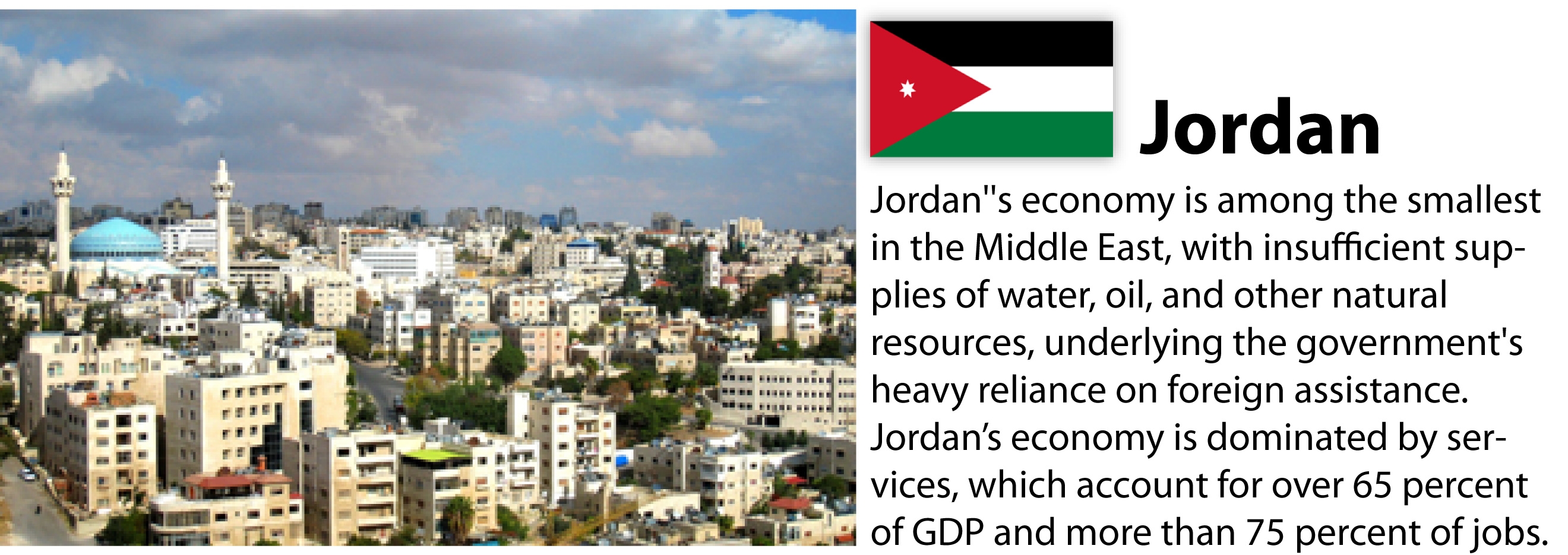
Jordan''s economy is among the smallest in the Middle East. Jordan’s economy is dominated by services, which account for over 65 percent of GDP and more than 75 percent of jobs. Jordan’s natural resources are potash and phosphate, agricultural land is limited and water is considerably scarce. With insufficient supplies of water, oil, and other natural resources, the government is heavily reliance on foreign assistance. Other economic challenges for the government include chronic high rates of poverty, unemployment, inflation, and a large budget deficit. Jordan has made significant headway with privatisation. The Jordanian economy is private-sector oriented. Accordingly, direct state ownership is relatively small. It is significant only in the mining sector (phosphates and potash) and in public utilities (electricity, water, communications, and bus, railway and air transport). Jordan has experienced strong economic growth (more than seven percent annually) with a remarkable upward trend since 2004. Much of this growth is due to rising exports, its location as a services hub to Iraq, and private capital inflows. The global economic slowdown and regional turmoil, however, have depressed Jordan''s GDP growth, impacting export-oriented sectors, construction, and tourism. The regional unrest has generated adverse spillover effects on economic activity in the Kingdom, driven by a retrenchment in investment, tourism and exports which also suffered from the continued poor performance of the world economy. Economic challenges for the government include chronic high rates of poverty, unemployment, inflation, and a large budget deficit. The kingdom has the world’s fourth-largest reserves of oil shale (about 40 billion tons), an organic-rich, fine-grained sedimentary rock from which liquid hydrocarbons (shale oil) can be produced. Shale oil is a substitute for conventional crude oil, and the oil can also be burned directly for power production similar to coal. Shale could help strengthen the fiscal position of Jordan whose economy has been impacted by the regional upheaval in the Arab world.
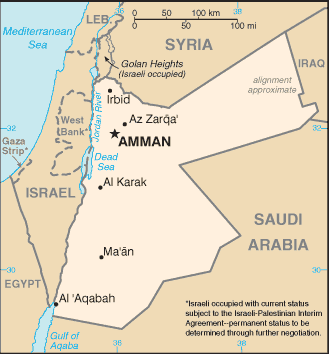
Essential Information Area: 89,342 sq km
Visas are required for US, UK and all European nationals; a seven-day tourist can be obtained at the airports and frontiers. For stays exceeding three months a residence permit is required.
|
|
 Current local time
Basic Economic Indicators
Jordan: Economic and International trade indicators {arimodule id="648" comment="Jordan: Economic indicators"}{/arimodule} Source: IMF
{mprestriction ids="1,2,3"}
Economic growth {arimodule id="649" comment="Jordan: Real GDP growth"}{/arimodule} Source: IMF
Size of the economy: GDP ($ Billion) {arimodule id="650" comment="Jordan: Nominal GDP"}{/arimodule} Source: IMF
Gross Domestic Product by economic activity 2010 {arimodule id="651" comment="Jordan: GDP by kind of economic activity"}{/arimodule} Source: IMF
Jordan: current account ($ Billions) {arimodule id="652" comment="Jordan: Current Account Balance"}{/arimodule} Source: IMF
Jordan: current account (% of GDP) {arimodule id="653" comment="Jordan: Current Account Balance (% of GDP)"}{/arimodule} Source: IMF
Ease of Doing Business Rank 2015
{arimodule id="590" comment="Ease of Doing Business Rank 2015"}{/arimodule}
Source: World Bank
Foreign Trade and Foreign Investment
Jordan total exports and imports ($ billion) {arimodule id="654" comment="Jordan: Exports and Imports"}{/arimodule} Source: IMF
Jordan: Foreign Direct Investment (FDI) {arimodule id="655" comment="Jordan: Foreign direct investment flows "}{/arimodule} Source: UNCTAD
Trade between Switzerland and Jordan
Swiss total Exports to the Arab World by Country 2014: Swiss Francs
{arimodule id="301" comment="Swiss total exports to the Arab world 2014, by country: Swiss Francs"}{/arimodule}
Source of data: Swiss customs
Swiss total Exports to the Arab World 2014: (Portion of total exports)
{arimodule id="300" comment="Swiss total exports to the Arab world 2014: Swiss Francs"}{/arimodule}
Source of data: Swiss customs
Swiss Total Imports from the Arab world by country 2014: Swiss francs
{arimodule id="292" comment="Swiss Imports from the Arab world 2014"}{/arimodule}
Source: Swiss customs
Swiss Total Imports from the Arab world 2014 (Portion of the total imports)
{arimodule id="302" comment="Swiss Total Imports from the Arab world 2014 (Portion)"}{/arimodule}
Source: Swiss customs
Swiss main exports/imports with Jordan 1985-2014 (Million CHF)
{arimodule id="525" comment="Swiss main exports/imports with Jordan 2007-2014"}{/arimodule}
Swiss main exports/imports with Syria, Lebanon, Palestine and Jordan: 1985-2014 (Million CHF)
{arimodule id="541" comment="Swiss main exports/imports with Levantines 1984-2014"}{/arimodule}
Levantines (Syria, Lebanon, Palestine, Jordan)
Swiss exports/imports with the Arab world (Million CHF)
{arimodule id="516" comment="Swiss main exports, imports with the Arab world 2014 (Million CHF)"}{/arimodule}
Source: Swiss customs
Swiss main exports to the Arab world 2014 (CHF)
{arimodule id="544" comment="Swiss main exports to the Arab world 2014 (CHF)"}{/arimodule}
Swiss main Imports from the Arab world 2014
{arimodule id="545" comment="Swiss main imports from the Arab world 2014 (CHF)"}{/arimodule}
Swiss main exports to Jordan 2014 (Million CHF)
{arimodule id="558" comment="Swiss main exports to Jordan 2014 (CHF)"}{/arimodule}
Swiss main imports from Jordan 2014 (Million CHF)
{arimodule id="559" comment="Swiss main imports from Jordan 2014 (CHF)"}{/arimodule}
{/mprestriction}
Swiss Exports to the Arab world by commodity comparaisons between the Arab countries
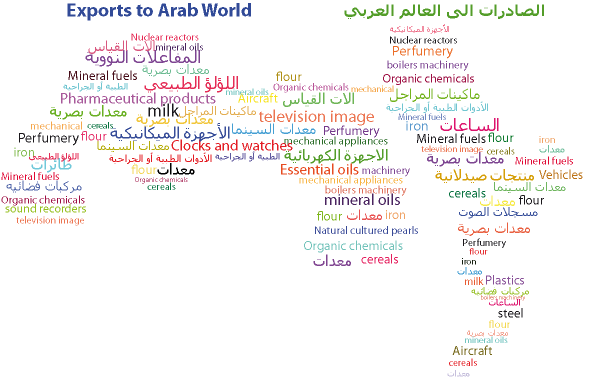
Swiss Imports from the Arab world by commodity comparaisons between the Arab countries