Qatar
|
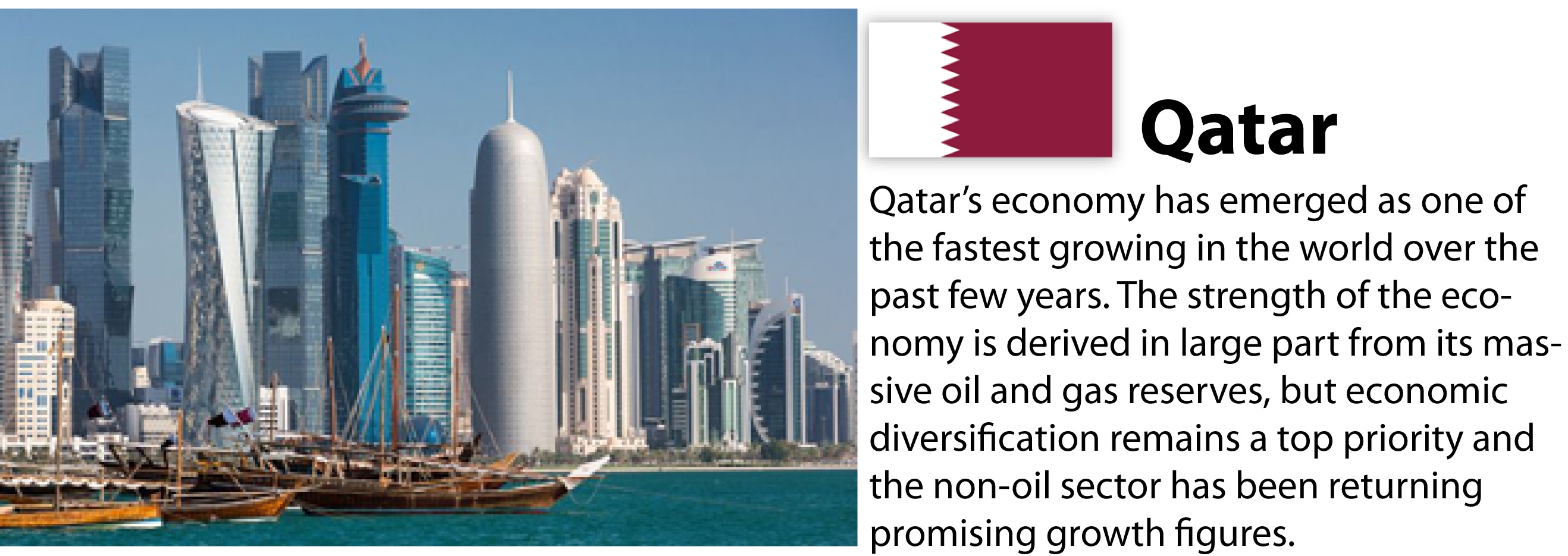
Economy of Qatar Qatar’s economy has emerged as one of the fastest growing in the world over the past few years. The strength of the economy is derived in large part from its massive oil and gas reserves, but like most other Gulf states, economic diversification remains a top priority and the non-oil sector has been returning promising growth figures. Even without government support, certain sectors, such as real estate, look set to enjoy sustained growth thanks to demand from a young and rapidly growing population. Tourism is another area of high potential as officials carve out Qatar’s identity as a centre of business and cultural tourism. While the government is still the leading force in overall economic development, it is encouraging the private sector to take a stronger role while bringing increased focus to small and medium-sized enterprises. The vast gas wealth was only discovered in 1971 - with estimated reserves of more than 900 trillion standard cubic feet - or about 10 per cent of the world's known reserves. The problem was Qatar was not close enough to potential customers for it to be of any commercial benefit. It was only in the mid 1990s that Qatar started to borrow heavily on international markets to invest in a series of industrial facilities to chill the gas to liquid form so it could be transported by ship around the world. It was a huge risk but one that set the tiny country on the road to becoming the world's largest exporter of liquefied natural gas. As gas production increased every year so, too, did the country's economic output. Nominal GDP has grown tenfold in a decade to $186bn. In the five years to 2016, Qatar plans to spend $125bn on infrastructure projects alone. During the last 5 years, the Qatari real economy has grown by an average of 15.5 percent per year as the country's gas and LNG output expanded. The development of the country's manufacturing sector, which includes downstream processes such as gas-to-liquids (GTLs), petrochemicals and fertilizer production, has been proceeding apace and is a major focus of Qatar's diversification strategy. The IMF has projected that growth in Qatar’s non-hydrocarbon sector will range between 9% and 10% in the medium term, while the hydrocarbon sector is projected to grow between 1.1% and 3.5%.
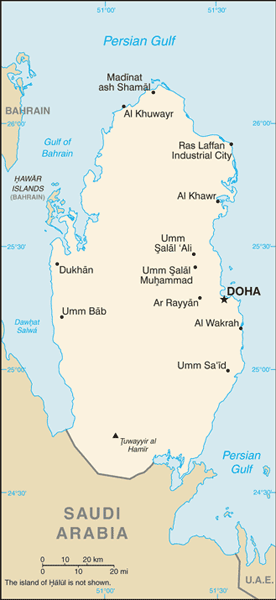
Essential Information Area: 11,427 sq km Education: Of total population 96% age 15 and over can read and write. (2010)
Visa Requirements: Visas for visits of up to 30 days are not required by nationals of some Arab countries and those born and resident in the UK. Other passport holders, if staying for more than 72 hours, must obtain visas from Qatar representatives before arrival. In some cases a 'No Objection Certificate' (NOC) applies instead of a visa; one should check before departure.
|
|
 Current local time
Basic Economic Indicators
Qatar: Economic and International trade indicators
{arimodule id="737" comment="Qatar: Economic indicators "}{/arimodule}
Source: IMF, CIA factbook.
{mprestriction ids="1,2,3"}
Economic growth
Qatar: Real GDP growth (oil and Non-oil growth)
{arimodule id="738" comment="Qatar: Real GDP growth (oil and non-oil growth) "}{/arimodule} Source: IMF
Qatar: GDP growth (Historical data) {arimodule id="739" comment="Qatar: Real GDP growth (1980-2017)"}{/arimodule}Source: IMF
Size of the economy: GDP ($ Billion) {arimodule id="740" comment="Qatar: Nominal GDP ($ Billions)"}{/arimodule}Source: IMF Source: IMF
Qatar: Gross Domestic Product by economic activity 2010 {arimodule id="741" comment="Qatar: GDP by kind of economic activity"}{/arimodule}Source: IMF
Qatar: Current account balance ($ Billions) {arimodule id="742" comment="Qatar: Current Account Balance ($ billion)"}{/arimodule}Source: IMF
Qatar: Total Government Debt (% GDP) {arimodule id="743" comment="Qatar Total Govt. Debt (% of GDP)"}{/arimodule}Source: IMF
Ease of Doing Business Rank 2015 {arimodule id="590" comment="Ease of Doing Business Rank 2015"}{/arimodule} Source: World Bank
Foreign Trade and Foreign Investment
Qatar: Total exports and imports ($ billion) {arimodule id="744" comment="Qatar: Exports and Imports ($ billion)"}{/arimodule}Source: IMF
Qatar: Foreign Direct Investment (FDI) {arimodule id="745" comment="Qatar FDI ($ million)"}{/arimodule}Source: UNCTAD
Energy Sector
Oil Reserves by country 2015 (Trillion Cubic Feet)
{arimodule id="603" comment="Oil Reserves 2015"}{/arimodule}
Source: EIA
Gas Reserves by country 2015 (Billion Barrels)
{arimodule id="602" comment="Gas Reserves 2015"}{/arimodule}
Source: EIA
Oil Price
Crude Oil Export Price (US$/bbl)
{arimodule id="599" comment="Crude Oil Export Price 2012-2019 "}{/arimodule} Source: IMF
Qatar: Oil supply and Exports (Thousand Barrels Per Day) {arimodule id="746" comment="Qatar: Total Oil Supply and Exports "}{/arimodule}Source: IMF
Qatar: Dry Natural Gas Production (Billion Cubic Feet) {arimodule id="747" comment="Qatar: Gas Production and Exports "}{/arimodule}Source: IMF
Qatar: Gas Exports by Destination 2013 {arimodule id="748" comment="Qatar: Gas exports by destination"}{/arimodule}Source: EIA
Trade between Switzerland and Qatar
Swiss total Exports to the Arab World by Country 2014: Swiss Francs
{arimodule id="301" comment="Swiss total exports to the Arab world 2014, by country: Swiss Francs"}{/arimodule}
Source of data: Swiss customs
Swiss total Exports to the Arab World 2014: (Portion of total exports)
{arimodule id="300" comment="Swiss total exports to the Arab world 2014: Swiss Francs"}{/arimodule}
Source of data: Swiss customs
Swiss Total Imports from the Arab world by country 2014: Swiss francs
{arimodule id="292" comment="Swiss Imports from the Arab world 2014"}{/arimodule}
Source: Swiss customs
Swiss Total Imports from the Arab world 2014 (Portion of the total imports)
{arimodule id="302" comment="Swiss Total Imports from the Arab world 2014 (Portion)"}{/arimodule}
Source: Swiss customs
Swiss exports/imports with the Arab world (Million CHF)
{arimodule id="516" comment="Swiss main exports, imports with the Arab world 2014 (Million CHF)"}{/arimodule} Source: Swiss customs
Swiss main exports/imports with the Gulf region (Million CHF)
{arimodule id="540" comment="Swiss main exports/imports with Gulf Region 1984-2014"}{/arimodule} Source: calculations based on Swiss customs data
Gulf region (Bahrain, Kuwait, Oman, Qatar, Saudi Arabia, UAE)
Swiss main exports/imports with Qatar 1985-2014 (Million CHF)
{arimodule id="533" comment="Swiss main exports/imports with Qatar 2007-2014"}{/arimodule} Source: Swiss customs data
Swiss main exports to the Arab world 2014 (CHF)
{arimodule id="544" comment="Swiss main exports to the Arab world 2014 (CHF)"}{/arimodule}
Swiss main Imports from the Arab world 2014
{arimodule id="545" comment="Swiss main imports from the Arab world 2014 (CHF)"}{/arimodule} Source: Swiss customs
Swiss main exports to Qatar 2014 in Swiss Francs
{arimodule id="574" comment="Swiss main exports to Qatar 2014 (CHF)"}{/arimodule} Source: Swiss customs data
Swiss main imports from Qatar 2012 in Swiss Francs
{arimodule id="575" comment="Swiss main imports from Qatar 2014 (CHF)"}{/arimodule}Source: Swiss customs data
{/mprestriction}
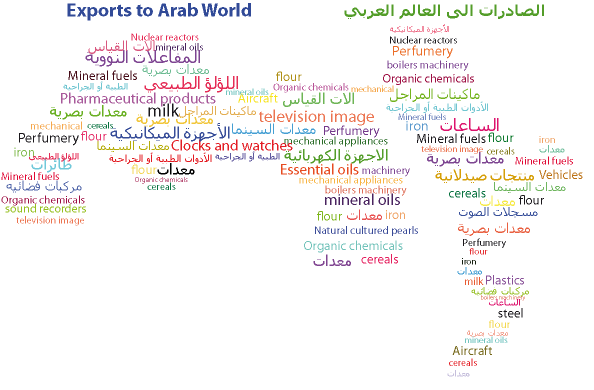
Swiss Exports to the Arab world by commodity comparaisons between the Arab countries
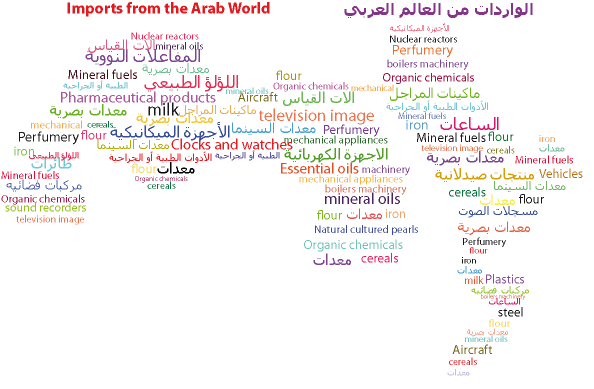
Swiss Imports from the Arab world by commodity comparaisons between the Arab countries