Artificial Intelligence in an Unequal World: Unlimited Opportunities Await Entrepreneurs
The New Economy: Those Who Own AI Write the Rules
Artificial intelligence is unlike any technological wave the world has seen before. It is not merely redefining how companies operate - it is redrawing geopolitical boundaries, separating digital powerhouses from developing economies scrambling to keep pace. While AI promises unprecedented productivity and vast economic opportunity, its concentration in the hands of a few firms and nations threatens to widen an already yawning global divide.
In an era of dizzying economic velocity, leadership is no longer forged by ideas alone, but by the agility to surf waves of deep tech - chief among them, AI. This is not just a technical upgrade; it is a wholesale shift in how we think, work and scale. Imagine a world where AI drafts your legal contracts, classifies your customer data, devises your ad campaigns, and builds your first product - all in a matter of days. This is no longer science fiction. It is a fast-unfolding reality -and one that demands swift, strategic action from entrepreneurs.
AI as a Geoeconomic Force
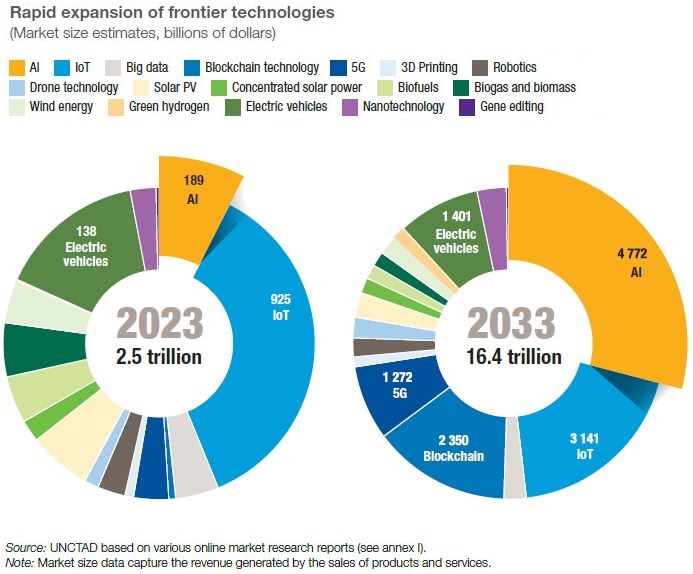
According to UNCTAD’s Technology and Innovation Report 2025, the global market for frontier technologies is set to reach $16.4 trillion by 2033. AI will claim the lion’s share - an estimated $4.8 trillion. What sets this wave apart is not just the automation of repetitive tasks, but its foray into high-level cognitive domains long reserved for humans - legal analysis, medical diagnostics, and creative design, to name a few.
Unlike past technologies, AI has the potential to reshape a broad swathe of knowledge-intensive tasks once monopolized by highly skilled workers. Generative AI, for example, can produce text, generate images and video, write code, and detect complex patterns in data for knowledge-based services. Research so far suggests that companies deploying AI - especially those in services or employing skilled talent - can reap significant productivity gains.
But what does this mean for an entrepreneur in Riyadh, Nairobi, or São Paulo? The answer is both sobering and empowering: the real growth opportunities lie in spotting the gaps - and building AI-powered, locally grounded solutions in fields like education, healthcare, agriculture, and finance.
The AI Titans: Market Power Meets Technological Might
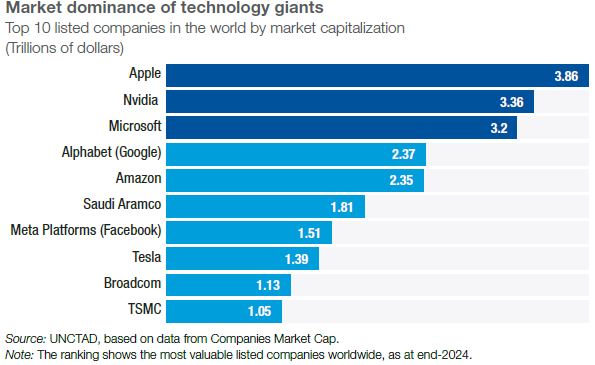
The world’s most valuable companies are no longer oil giants or industrial titans - they are the architects of frontier technologies. Today, Apple, Nvidia, and Microsoft each boast a market capitalization exceeding $3 trillion — roughly equivalent to the entire GDP of the African continent or that of the United Kingdom and Northern Ireland, the world’s sixth-largest economy. All five of the world’s most valuable firms are American, and three of the top ten — Nvidia, TSMC, and Broadcom — are semiconductor specialists, heavily invested in AI and at the heart of this technological shift.
This concentration of corporate power is mirrored in research and development spending. In 2022, a staggering 40% of all corporate-funded R&D worldwide was carried out by just 100 companies. About half of these are headquartered in the United States, led by tech behemoths such as Alphabet, Meta, Microsoft, and Apple. China, now home to around 13% of these top R&D spenders - up from just 2% a decade ago—follows closely behind, with Huawei and Tencent among its leaders. This marks a sharp departure from the traditional R&D powerhouses like Germany, Japan, South Korea, Switzerland, and the United Kingdom.
Strikingly, aside from China, no developing country has a single firm among the world’s top 100 R&D investors. This dominance — whether by companies or countries—risks entrenching global technological divides. The further the leaders race ahead, the harder it becomes for laggards to catch up.
The AI Divide: A Widening Gap Between Nations
Artificial intelligence may hold extraordinary promise, but harnessing its full potential requires more than ambition—it demands the right infrastructure, governance, and talent. The latest UNCTAD report casts a stark light on the growing digital chasm between nations, warning that the rise of AI may deepen, not bridge, global inequality.
Take infrastructure, for instance. The United States is home to one-third of the world’s top 500 supercomputers and commands over half of global high-performance computing capacity. Most data centres are concentrated in the US as well. In contrast, AI infrastructure in developing nations remains woefully limited—with a few notable exceptions such as Brazil, China, India, and Russia. This imbalance curtails the ability of lower-income countries to adopt or develop AI systems independently.
The divide extends beyond hardware. Developing countries trail in AI service provision, investment, and knowledge generation. Without deliberate intervention, these gaps risk becoming structural handicaps.
Towards Inclusive AI: Three Pillars for Progress
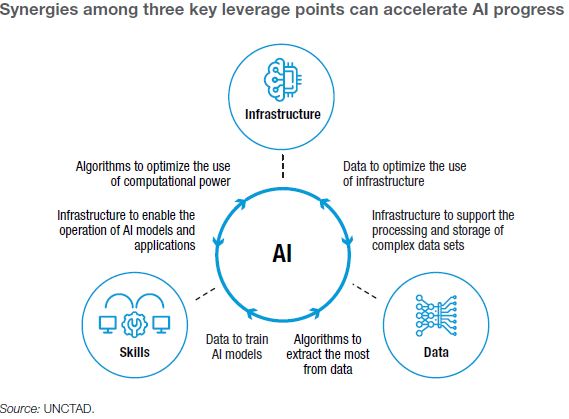
To ensure a more equitable AI future, the report calls for inclusive development strategies. AI, it insists, must complement—not replace—human labour. Production models must be restructured to fairly distribute the benefits among nations, firms, and workers. The report outlines three pillars critical to accelerating global AI readiness:
- Infrastructure
Electricity and internet access are just the starting point. What matters now are high-end computational resources—such as GPUs and supercomputing clusters. The US alone controls a third of the world’s top supercomputers. Most African nations do not appear in the rankings at all.
Even middle-income countries like Brazil or South Africa lack the data centre capacity to host large-scale AI models like GPT-4 or Claude. Without this infrastructure, local researchers are unable to test or train their own models, forcing dependence on foreign platforms.
- Data
AI thrives on data—but in many developing countries, data is scarce, fragmented, or legally unusable. Strong governance frameworks like the EU’s GDPR give countries a competitive edge in attracting AI investment.
By contrast, countries such as Nigeria and Bangladesh face challenges due to weak regulatory regimes and a lack of standardized data policies. This hampers local model development and raises serious concerns about data privacy.
- Skills
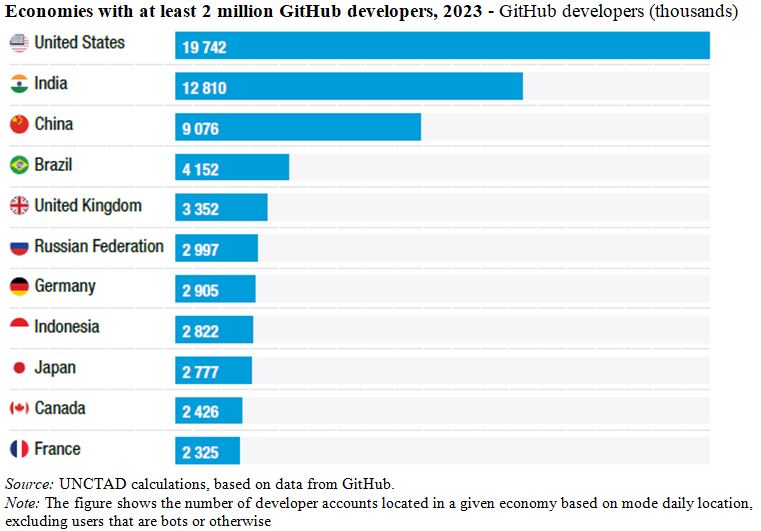
Perhaps the most critical factor is talent. Without developers, data scientists, and algorithm engineers, no country can meaningfully compete in the AI race. The US leads in developer numbers on platforms like GitHub, followed by India and China.
Still, there are signs of progress. Nigeria, Ghana, and Kenya have seen a 40% surge in developer numbers in recent years, positioning themselves as emerging regional hubs. Nigerian startup Andela, for instance, has built a pan-African network to train and deploy AI developers across the continent.
The Talent Race: Skills as Strategic Capital in the Age of AI
Skills are fast becoming the defining currency in the global race to harness artificial intelligence. For nations vying for strategic positioning in the AI economy, building a robust pipeline of technical talent is not optional—it is imperative. Advanced economies and rising powers alike are investing heavily in AI-related skills as a core pillar of their competitiveness.
Unsurprisingly, the United States leads the pack with the largest number of developers on GitHub, followed by India and China—both of which also boast the world’s largest populations. These two Asian giants have assembled formidable clusters of AI developers, placing them in a strong position to lead in AI innovation and scientific output.
China, in particular, benefits from both low-cost, high-volume data access and a rapidly scaling digital infrastructure. India and Brazil have similarly cultivated sizeable developer communities. Meanwhile, several developing countries in Africa and Southeast Asia have made quiet but meaningful progress by expanding cross-border internet infrastructure and improving connectivity.
UNCTAD data reveals that some of the fastest growth in developer numbers has occurred in emerging tech hubs across the Global South. Nigeria, Ghana, and Kenya have each recorded growth rates exceeding 40%, positioning themselves as promising centers for innovation and digital entrepreneurship. Latin America, too, is gaining ground, with countries such as Argentina, Bolivia, Colombia, and Brazil reporting strong increases in developer activity.
In the Asia-Pacific region, India remains dominant, but Vietnam, Indonesia, and the Philippines are not far behind, each with a substantial and growing developer base. These trends suggest that while the AI talent gap remains real, it is not immutable. With the right investments in education and infrastructure, the next AI success story could just as likely emerge from Nairobi or Manila as from Silicon Valley.
Measuring Momentum: The Frontier Technologies Readiness Index
To gauge how well countries are positioned to adopt cutting-edge technologies like artificial intelligence, UNCTAD has launched the Frontier Technologies Readiness Index. Unsurprisingly, the United States tops the rankings, followed by Sweden, the United Kingdom, and the Netherlands, with Switzerland in sixth place. These nations owe their lead to strong investments in R&D, high-quality educational institutions, and thriving innovation ecosystems.
Yet the list also reveals a rising tide in the Global South. China climbed to 21st place, up from 28th; India leapt to 36th from 48th; and Brazil advanced to 38th from 40th. These gains reflect ambitious government policies in education and innovation, as well as partnerships with the private sector to establish AI-focused centers of excellence.
India’s rise, for example, is partly the result of close coordination between government, academia, and industry. Notable initiatives include the Indian Institutes of Technology in Hyderabad and Kharagpur, the Kotak Centre for AI and Machine Learning at the Indian Institute of Science, and the NASSCOM Centre of Excellence in Data Science and AI.
Brazil, too, is nurturing AI talent through national and state-level initiatives. In São Paulo, the state research foundation has created a network of applied research centers in partnership with universities and private-sector firms.
By contrast, many Arab countries—despite their lofty digital ambitions—remain further down the rankings. With the exception of the UAE and Saudi Arabia, the gap between vision and readiness remains wide, as the data shows.
As AI reshapes the global innovation landscape, the message is clear: aspiration must be matched by institutional capacity, strategic investment, and a relentless focus on human capital.
How AI Shapes Work and Productivity: Four Channels of Disruption
Artificial intelligence is not a singular force—it is a multi-channel disruptor, transforming work and productivity in parallel ways. Its impact is unfolding along four main avenues:
- Replacing Human Labour
AI substitutes for human workers in tasks where machines outperform in efficiency and scale. This shifts reliance from labour to capital.
Example: In banking, AI can scan thousands of transactions in real time, flagging fraud or anomalies—far faster than manual review.
- Augmenting Human Labour
Rather than replacing humans, AI often enhances human capabilities by taking over repetitive or low-value tasks—freeing up workers to focus on complex, interpersonal, or strategic functions.
Example: In healthcare, AI helps diagnose illnesses through medical image analysis, sometimes spotting conditions even skilled professionals might miss.
- Deepening Automation
AI replaces outdated, less efficient technologies, accelerating the automation of both front-end and back-end processes.
Example: AI-powered chatbots, such as those driven by generative models, deliver customer support far superior to traditional rule-based systems.
- Creating New Jobs
Far from eliminating all work, AI also gives rise to new occupations.
These include:
- AI Trainers – who refine and update machine learning models;
- AI Explainers – who adapt systems to specific business needs;
- AI Sustainers – who ensure ethical, secure, and responsible use of the technology.
The result is not just a reallocation of labour—but a redefinition of the skills and roles that matter in the modern economy.

AI: Public Good or Private Monopoly?
The internet’s trajectory offers a cautionary tale: in the absence of global governance, transformative technologies risk becoming tools of monopoly. Artificial intelligence, despite its staggering potential, may be no different—unless the world acts decisively.
UNCTAD’s report warns against leaving AI entirely in the hands of the private sector, where profit—not public interest—often dominates. Instead, it calls for AI to be treated as a global public good, akin to healthcare or climate action. Given AI’s intangible, borderless nature—software, models, and algorithms can be replicated and deployed almost anywhere—the report stresses the urgency of international coordination to ensure fair access, responsible innovation, and societal benefit.
From Policy to Practice: A Blueprint for Inclusive AI
- National Strategies with Global Vision
Developing countries must craft comprehensive AI policies grounded in sustainability, equity, and long-term competitiveness. With frontier technologies like AI threatening to erode the traditional cost advantage of cheap labour, developing economies must rethink their economic models. Avoiding digital dependency requires integrating AI into broader industrial policy.
- Invest in Human Capital
Workforces must not just adapt—they must lead. Vocational and higher education systems should prioritize AI literacy, upskilling, and worker inclusion in the design and governance of AI tools. AI should complement—not replace—human labour.
National acceleration strategies should tailor AI solutions to local infrastructure and datasets, while simplifying user interfaces and forming strategic partnerships to access needed resources. That includes digital literacy programmes, job reskilling, and inclusive economic planning. Fiscal policy also has a role: targeted R&D funding and tax incentives can support human-centric innovation and reduce brain drain.
- Establish Sovereign AI Investment Funds
Governments should take a strategic stance, assessing national AI capacity across three pillars: infrastructure, data, and skills. Identifying gaps will help craft evidence-based policies to stimulate digital growth and enhance global competitiveness.
Strengthening these pillars is essential. Reliable access to electricity and internet is the baseline; ethical and legal standards for data sharing are vital for safe innovation; and AI education—from early schooling to professional training—will determine a country’s ability to compete.
- Adopt Secure, Open Data Policies to Catalyse Local Innovation
Open and ethical data governance is critical. A multistakeholder approach is needed to balance innovation with public trust and social inclusion—especially for vulnerable or marginalised groups. Ensuring that no one is left behind in the digital transformation is as much a social imperative as a technological one.
AI for All: Vision, Not Hype
What UNCTAD proposes is not a techno-utopia, but a grounded development agenda. AI for all requires political will, institutional coordination, and long-term investment in people and knowledge ecosystems. Above all, it requires international cooperation. AI’s most pressing challenges—security, privacy, algorithmic bias, data control—are inherently transnational.
The report concludes with a stark reminder: AI must not become a privilege of the rich or a tool of digital empires. It must be a shared global resource. But that won’t happen by default. It will take entrepreneurial leadership—founders who can think locally, act globally, and build business models that solve real problems.
AI is the greatest commercial opportunity of the decade.
The real question is: will you ride the wave, or watch it break from the shore?