The Global Tech Battle: Can China Overcome the U.S.?
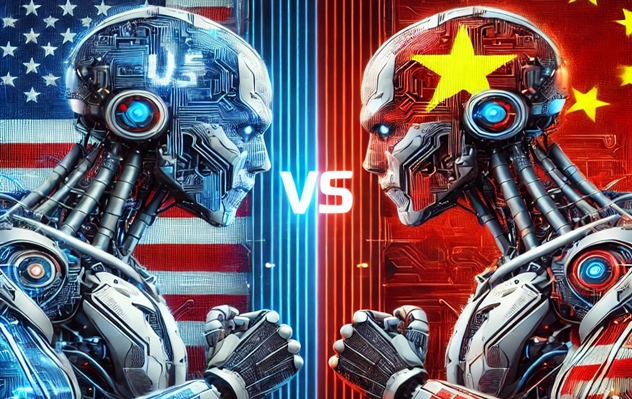
China’s DeepSeek Shakes the Foundations of AI Dominance
A few days ago, the Chinese application DeepSeek was launched as a competitor to ChatGPT, in what was considered a major shock that shook the world. Former U.S. President Donald Trump stated that this should sound the alarm and push the United States to work harder to stay at the forefront of artificial intelligence technology.
This article explores the aspects of the long-standing economic battle between China and the United States and how China has managed to advance using an economic model different from the West. While Western economies focus on innovation and the creation of new products, China has leveraged a strategy of replicating existing inventions to expand production and drive economic growth. This approach has given China a significant advantage, enabling it to compete effectively, develop its economy, and achieve substantial economic expansion.
The article delves into key aspects of the economic conflict, particularly regarding artificial intelligence, semiconductor technology, and quantum technology.
The launch of DeepSeek is part of an intensified competition and a deeply rooted struggle between the two economic superpowers. There are several other fronts in this rivalry, such as the fierce semiconductor chip war between the U.S. and China, as well as the battle against Huawei in the U.S. Another significant aspect is the bitter race for dominance in quantum technology, with both nations striving to enhance their capabilities in the field. China has already developed and made available third-generation quantum computers for public use.
The AI competition stands at the top of this conflict, with the launch of DeepSeek, which shocked the world by demonstrating China's ability to develop such a program at a low cost while utilizing an innovative AI approach that optimizes time and effort.
Another major front in this battle is the confrontation between Huawei and NVIDIA, one of the most prominent aspects of the U.S.-China technological war. The United States imposed sanctions on Huawei, believing it could cripple the Chinese tech giant in its early stages. However, Huawei successfully overcame American restrictions and remained resilient. The company has also expanded beyond telecommunications into the electric vehicle market, with ambitions to dominate the global EV industry.
DeepSeek: The Technological Earthquake That Shook the World
On January 20, 2025, a Chinese startup named DeepSeek launched its groundbreaking AI model, DeepSeek R1. This open-source AI model astonished the world—not only because of its capability to compete with the most advanced American models, but also due to its remarkably low cost of approximately $5.6 million, which is nearly ten times cheaper than its American counterparts, which cost around $100 million. This was not just a technological achievement but a turning point in the global AI race between China and the U.S.
The launch of DeepSeek was nothing short of a technological earthquake. Within days of DeepSeek R1’s release, financial markets experienced a sharp decline, with the U.S. and European tech sectors losing over $1 trillion in market value. Among the biggest casualties was NVIDIA, which suffered a staggering $589 billion loss in a single day—marking the largest drop in U.S. stock market history.
At the same time, the release of DeepSeek coincided with a major political event in the U.S.: the inauguration of Donald Trump as the new President. This timing amplified the issue’s significance, with Trump immediately stating that this development "should sound the alarm" and serve as a wake-up call for the United States to double its efforts in AI research and development to maintain its technological dominance.
Who is the Mastermind Behind DeepSeek?
Behind the resounding success of DeepSeek stands a young Chinese prodigy named Liang Wenfeng. A mathematical genius from a small and impoverished town in China, Liang displayed an early obsession with data analysis. By 2015, he had launched an AI-powered investment fund that leveraged artificial intelligence to analyze financial markets.
In 2019, Liang began purchasing thousands of NVIDIA GPUs, a move that puzzled many at the time. However, when OpenAI launched ChatGPT in 2022, it became clear that Liang had been laying the groundwork for a Chinese AI powerhouse capable of competing with America’s leading AI giants.
Conspiracy Theories: Is DeepSeek a Chinese Hoax?
With DeepSeek’s astonishing success, conspiracy theories emerged rapidly. One of the most vocal skeptics was Neil Khosla, the CEO of a Silicon Valley AI company. He posted on X (formerly Twitter):
“What the Chinese have done is an elaborate economic and psychological hoax aimed at bankrupting the American AI sector… They claim their costs are unbelievably low just to force U.S. companies to offer free services, making competition impossible!”
This claim gained significant traction among American investors, especially after the catastrophic stock market crash. Many began to question: Does China have a well-orchestrated plan to dominate the AI industry?
Why Does DeepSeek Pose a Threat to the United States?
Despite differing opinions and speculations, the strategic blow dealt by China to the AI market was not just about DeepSeek R1’s performance, but also the brilliant strategy used to surpass American companies like OpenAI and Google. Here are the key factors that make DeepSeek a serious threat to the U.S.:
- Higher Efficiency at a Lower Cost
While OpenAI spent over $100 million to train GPT-4, DeepSeek managed to train its AI model for just $5.6 million. This was possible due to advanced techniques like Mixture of Experts (MoE), which efficiently distributes processing tasks among multiple specialized sub-models. In contrast, American AI models rely on encyclopedic architectures, requiring them to scan massive databases—increasing both costs and energy consumption.
- Bypassing U.S. Sanctions
Despite U.S. sanctions restricting China's access to advanced chips, DeepSeek exploited loopholes in export regulations to acquire NVIDIA’s high-end GPUs before tighter restrictions were imposed in 2023. This allowed the company to build and train its AI model, effectively neutralizing American attempts to limit China’s AI development.
- Leveraging Chinese Talent
Unlike American firms that rely on global AI experts, DeepSeek built its model exclusively with Chinese talent. This reflects a major shift in the global AI landscape—China now accounts for nearly 50% of the world’s top AI researchers. By developing its own expertise, China is reducing its dependence on U.S. universities and Silicon Valley researchers.
- Free and Open Access
In a shocking move, DeepSeek made its model open-source, meaning anyone in the world can use or develop it for free. This decision accelerates adoption and enhances its global impact, creating a powerful alternative to proprietary U.S. AI models like GPT-4.
How Will This Impact the Future of Artificial Intelligence?
There is no doubt that DeepSeek’s breakthrough has placed American companies under an unprecedented challenge. Previously, the prevailing belief was that AI development required massive investments in computational infrastructure. However, the Chinese company has proven that remarkable results can be achieved with fewer resources, provided the right technologies are utilized.
For years, the United States operated under the assumption that it monopolized AI technologies. Now, it finds itself forced to rethink its strategies as China rapidly catches up.
How Did DeepSeek Succeed Despite the U.S. Tech Sanctions?
One of the biggest mysteries surrounding DeepSeek's success is how China managed to train such an advanced AI model despite the U.S. semiconductor blockade. Since 2022, the United States imposed strict export restrictions on NVIDIA’s high-performance AI chips, making it nearly impossible for Chinese companies to acquire the necessary hardware for training AI models.
However, DeepSeek defied these barriers, escaping this technological prison through innovative and unexpected methods, including:
- Leveraging New Techniques to Reduce Processing Power Needs
Unlike American AI companies, which rely on hundreds of thousands of high-end chips, DeepSeek trained its model using only 2,048 NVIDIA H800 GPUs.
These H800 chips are a downgraded version of the H100 chips that U.S. firms use but were still sufficient for DeepSeek’s needs.
- Using the "Mixture of Experts" (MoE) Model
Instead of using a single, massive AI model, DeepSeek employed MoE, which divides tasks among multiple smaller, specialized models.
This reduces computational requirements, making training highly efficient while minimizing the need for thousands of high-end processors.
- Developing New Algorithms to Offset Computing Limitations
DeepSeek optimized its AI training process by ensuring that the model focuses only on the most relevant data instead of processing all information at once.
This dramatically reduced training costs and enhanced efficiency, allowing DeepSeek to train a high-performance model with limited resources.
- Utilizing Pre-Ban Stockpiles of U.S. Chips
DeepSeek’s parent company, High-Flyer Investment, had strategically purchased 100,000 NVIDIA A100 chips before the U.S. restrictions took effect.
This provided a massive advantage, allowing the company to bypass the U.S. sanctions and continue AI training at scale.
Why Did American Investors Panic?
The shock wasn’t just about DeepSeek’s performance—it was about its free and open-source model. Unlike ChatGPT-4, which requires a $200 monthly subscription, DeepSeek R1 was announced as completely free for everyone.
This directly threatened the profit-driven business models of U.S. AI companies. Investors immediately questioned:
Why would customers pay hundreds of dollars per month when they can get a comparable (or superior) service for free from China?
Even more alarming, if DeepSeek’s cost claims were accurate, it exposed a fundamental lie about AI development costs in the U.S.
If DeepSeek built a superior model for under $6 million, what does that say about the billions invested by American firms like OpenAI, Google, and Microsoft?
U.S. Response: The "Stargate AI" Project
Within days of DeepSeek’s release, the United States retaliated by announcing "Stargate AI", a $500 billion initiative to invest in AI infrastructure over the next four years.
Led by major U.S. tech firms like OpenAI, Microsoft, and Oracle, the initiative aims to reassert American dominance in artificial intelligence.
The goal is to massively expand computing power, data access, and algorithmic advancements—ensuring that the U.S. remains ahead of China in AI development.
The Big Question: Can the U.S. Catch Up?
With DeepSeek’s rapid success, a major uncertainty looms: Will this massive U.S. investment be enough to compete with DeepSeek, or has China already secured AI supremacy?
Semiconductor Technology: China Shakes Silicon Valley’s Throne
If the development of DeepSeek’s AI model is one of the key fronts in the intense U.S.-China tech war, then the race for semiconductor supremacy is equally critical.
For months, behind the scenes, Chinese tech companies have been quietly testing a new processor that could deliver a devastating blow to American chip giant NVIDIA.
This processor, known as Ascend 910C, is the latest breakthrough from Huawei. It is designed to be a powerful alternative to NVIDIA’s advanced AI chips, which were banned from China due to U.S. sanctions.
On August 13, 2024, The Wall Street Journal published a game-changing report. What it revealed was not just a technological breakthrough—it was proof that China had successfully bypassed the U.S. semiconductor blockade. Even more concerning for Washington, Huawei’s progress suggests that China may soon challenge NVIDIA’s dominance in the global AI chip market.
How Did Huawei Escape the U.S. Tech Blockade?
Since 2019, the United States blacklisted Huawei, cutting it off from American technology, especially high-performance AI chips like NVIDIA’s H100, which are essential for training advanced AI models.
However, instead of collapsing under pressure, Huawei made a bold counter-move. Despite strict sanctions, the company continued its R&D efforts and successfully designed and produced its own domestic AI processor, the Ascend 910C. According to Huawei, this new chip matches the performance of NVIDIA’s H100—and even surpasses it in some aspects.
The Move That Unsettled Washington
What raised alarms in Washington was that China’s top tech giants, including ByteDance (the owner of TikTok), Baidu, and state-owned telecom giant China Mobile, had begun purchasing and testing Huawei’s new processor.
Not only that, but reports indicate that initial orders have already surpassed 70,000 units, with a total value approaching $2 billion.
If Huawei succeeds in mass-producing these chips, it would mean that China no longer needs NVIDIA, posing a direct threat to U.S. dominance in the global semiconductor market.
How Did China Achieve This Breakthrough in the Semiconductor Industry?
In the past, it was widely believed that China would never catch up with U.S. semiconductor technology, given America’s dominance in advanced chip manufacturing. However, since 2023, the landscape has shifted dramatically as China has taken strategic steps to overcome U.S. sanctions and accelerate its semiconductor capabilities.
- Circumventing U.S. Sanctions
Huawei built an independent supply chain that operates without U.S. technology.
The company relied on local Chinese manufacturers like SMIC to produce 7nm chips—a major leap since China’s previous limit was 14nm.
Huawei’s investment arm, Hubble, strategically funded local chip firms, reducing China’s reliance on Western technologies.
- Developing Independent AI Chips
The Ascend 910C processor is not just a replacement for U.S. chips—it is emerging as a direct competitor to NVIDIA’s H100.
Chinese AI data centers are increasingly adopting Huawei’s chips, with 11 national AI centers now relying on Ascend processors.
- Reducing Dependence on NVIDIA Within China
Due to U.S. export restrictions, Chinese companies have scaled back their reliance on NVIDIA chips.
Reports indicate declining demand for weaker NVIDIA models (H20 & L20), which were specifically designed for the Chinese market under U.S. trade controls.
Meanwhile, demand for Huawei’s Ascend 910C is surging, signaling a major shift in China’s AI chip ecosystem.
Comparison of Chinese and American Companies
|
Sector |
Chinese Companies |
Market Share |
American Companies |
Market Share |
|
Artificial Intelligence |
DeepSeek, Baidu |
35% |
OpenAI, Google, Microsoft |
65% |
|
Semiconductors |
SMIC, Huawei |
30% |
NVIDIA, Intel, AMD |
70% |
|
Quantum Technology |
Alibaba, Huawei |
40% |
IBM, Google |
60% |
|
Electric Vehicles |
BYD, Huawei |
35% |
Tesla, GM |
65% |
Will China Become the Global Leader in Artificial Intelligence?
Projections indicate that if Huawei continues mass-producing its Ascend processors, it could force NVIDIA to completely withdraw from the Chinese market. This shift could fundamentally alter the dominance of U.S. companies in the AI industry.
NVIDIA's CEO, Jensen Huang, has already acknowledged that Huawei has become a serious competitor in AI chip development. He warned that Chinese companies may accelerate their own chip production, further reducing reliance on U.S. semiconductor firms.
What Can the U.S. Do?
Given China’s rapid advancements, the United States now faces two possible options:
- Imposing Additional Sanctions
- Tightening existing restrictions to prevent Huawei from accessing advanced technologies, either directly or indirectly.
- Expanding export bans to European and Japanese tech companies, blocking them from supplying key components to China.
Potential Challenges:
- China may retaliate by restricting exports of rare earth metals essential for semiconductor production.
- Sanctions could accelerate China’s self-sufficiency, further reducing U.S. influence.
- Increasing Domestic Investment in Chip Manufacturing
- Boosting local semiconductor production to compete with China’s AI hardware advancements.
- Encouraging companies like NVIDIA, Intel, and AMD to expand their manufacturing operations and reduce reliance on Chinese supply chains.
Potential Challenges:
- Building new chip factories (fabs) takes years and requires massive capital investments.
- China's semiconductor industry is growing rapidly, making it difficult for the U.S. to catch up in the short term.
Can Arab Companies Catch Up?
This technological breakthrough raises an important question in the Arab world: If a Chinese startup could achieve such a leap, why can't Arab companies compete globally?
The main challenge lies in low investment in research and development (R&D) and the brain drain of Arab talent to foreign countries. Below are key factors influencing this issue:
- The Potential in the Arab World
The Arab region has significant financial resources, thanks to oil and gas revenues, as well as a young and rapidly growing population that could play a major role in technological development.
Many Gulf countries are expanding their investments in AI and advanced technologies, but a major gap still exists between available potential and real-world progress.
- Challenges Facing Arab Tech Companies
Despite financial and human capabilities, several obstacles hinder Arab progress in AI and semiconductors:
- Weak Investment in R&D
· Arab countries spend far less on research & development compared to China (2.4% of GDP) and the U.S. (3.5%).
· Most Arab nations invest only 0.5% of their GDP in R&D—too little to drive innovation.
- Lack of Technological Infrastructure
· No advanced semiconductor manufacturing facilities exist in the Arab world.
· Chip manufacturing requires billions in investment in specialized factories.
· While China, South Korea, and the U.S. have major foundries (TSMC, Samsung, Intel), no Arab country has a competitive facility.
- Weak Supportive Legislation for Startups
· The tech sector needs a complete ecosystem of universities, labs, and business incubators.
· Intellectual property (IP) laws remain underdeveloped, making it hard for startups to protect innovations.
- Brain Drain
· Limited opportunities and funding force many Arab scientists and engineers to migrate to the West.
· Hundreds of Arab researchers work in top U.S. and Chinese tech companies, while no Arab system effectively retains them.
How Can the Arab World Catch Up in Technology?
Despite existing challenges, the Arab world still has massive opportunities to enter the AI and semiconductor race—but only if decisive actions are taken.
- Increasing Investment in Research & Development (R&D)
- Arab countries must raise R&D spending to 2-3% of GDP to drive innovation.
- Establish specialized AI and semiconductor research centers in partnership with leading global universities.
- Building Semiconductor Manufacturing Facilities
- Wealthy Arab nations should invest in chip manufacturing plants in collaboration with global leaders like TSMC and Samsung.
- Saudi Arabia and the UAE have already started investing in semiconductor production, but mass production is still years away.
- Supporting Startups & Innovation
- Governments should offer tax incentives and investment opportunities to tech startups.
- Establish AI-focused venture capital funds, similar to China’s approach in funding innovation.
- Attracting Arab Talent Back Home
- Implement incentive programs to bring back Arab scientists and engineers from abroad.
- Set up research centers and fellowship programs to attract top AI and tech talent.
Summary
The technological war between China and the United States has entered a new phase of escalation. For years, the U.S. has attempted to block China's advancement, closing doors to prevent it from developing cutting-edge technologies. However, the case of Huawei came as a shock, as U.S. sanctions pushed the company to seek innovative solutions, ultimately allowing it to surpass expectations and develop alternatives independent of American technology. As a result, China has transformed into a self-sufficient powerhouse, capable of competing with U.S. tech giants despite numerous obstacles. If China continues on this trajectory, it could mark the beginning of the end for U.S. dominance in AI and advanced technologies.
Amid this fierce U.S.-China rivalry, the Arab world faces major challenges in keeping up with technological advancements, despite its vast financial and human resources. The main obstacles include low investment in R&D, lack of advanced semiconductor infrastructure, weak regulatory support for startups, and ongoing brain drain. To overcome these barriers, Arab nations must take serious steps, including:
- Increasing investment in R&D
- Building semiconductor manufacturing plants
- Providing incentives for tech startups
- Attracting Arab talents back from abroad
By implementing these strategies, the Arab world can achieve technological independence and strengthen its role in the global digital economy.
A. Weak Investment in R&D
· Arab countries spend far less on research & development compared to China (2.4% of GDP) and the U.S. (3.5%).
· Most Arab nations invest only 0.5% of their GDP in R&D—too little to drive innovation.
B. Lack of Technological Infrastructure
· No advanced semiconductor manufacturing facilities exist in the Arab world.
· Chip manufacturing requires billions in investment in specialized factories.
· While China, South Korea, and the U.S. have major foundries (TSMC, Samsung, Intel), no Arab country has a competitive facility.
C. Weak Supportive Legislation for Startups
· The tech sector needs a complete ecosystem of universities, labs, and business incubators.
· Intellectual property (IP) laws remain underdeveloped, making it hard for startups to protect innovations.
D. Brain Drain
· Limited opportunities and funding force many Arab scientists and engineers to migrate to the West.
· Hundreds of Arab researchers work in top U.S. and Chinese tech companies, while no Arab system effectively retains them.